How Old Is Nationalism?
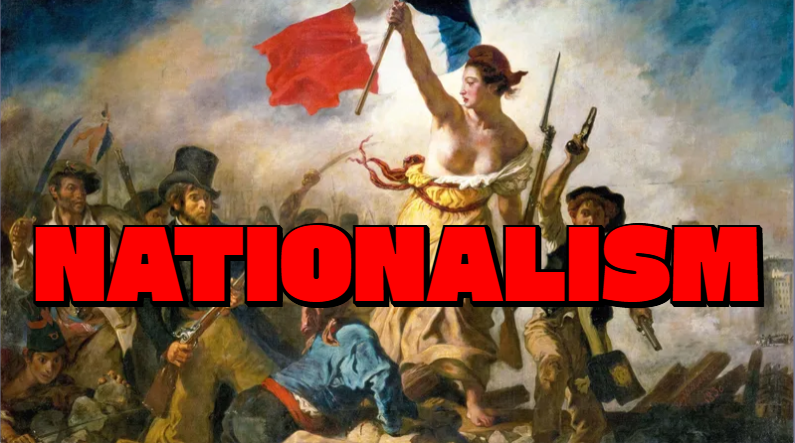
What comes first: your family, king, religion, or tribe? For much of human history, these were what people killed and died for. It may seem quite distant in 2026. But what if I said country? Would you die for yours?
Nationalism is a force that often compels people to self-sacrifice; it convinces them to serve a higher cause. This is true in any corner of our Earth, and it has played a defining role in human history for the past several centuries. But where did it come from? Since nationalism studies appeared as an academic field in the late 20th century, several theories have been put forward. Today, I thought I’d discuss the most prominent: Primordialism and Modernism.
Primordialism
The first theory put forward to explain the origins of nationalism was primordialism. It posits that nations are ancient and fixed entities rooted in preexisting ethnic ties such as language, culture, or blood. In other words:
“Primordialism” is an umbrella term used to describe the belief that nationality is a natural part of human beings—as natural as speech, sight, or smell—and that nations have existed from time immemorial. This is the view of nationalists themselves and was for some time the dominant paradigm among social scientists, notably historians. Primordialism also constitutes the layperson’s view of nations and nationalism.
If you have ever discussed history with a die-hard nationalist from any country, you probably have been exposed to a primordial account of their nation’s history. If we were to take my home country of Ireland as an example, the primordial narrative goes as follows:
Ireland’s origins as a nation spring from our Gaelic and Celtic ancestors thousands of years ago. This era was interrupted by the yoke of England, who colonized the country for eight hundred years. In the early 20th century, some of the nation broke free and took their natural place as a nation of the world. Northern Ireland remains unfree.
This narrative considers Ireland as an idea to be ancient and our independence as a return to normality. And yet, Ireland was never one unified country at any point in its history. The only time the island was under one government, it was under the British. Even if we focus on our pre-Norman history, the island was split among several hundred clans who fought among themselves. People belonged to tribes and were loyal to their chieftains. Primordialism allows for a new concept to be perceived as ancient. That is its power.
Consider Patrick Pearse, leader of the Irish nationalist revolt of 1916 that was to end in his own execution. As Coakley puts it:
For him the notion of national freedom was a unified, sacred and all-embracing construct, and was marked by ‘apostolic succession’, as it ‘passes down from generation to generation from the nation’s fathers.’ The idea of national freedom, in this view, is ‘not affected by the accidents of time and circumstance’, in that it ‘does not vary with the centuries, or with the comings and goings of men or of empires’ (Pearse 1916: 4-5). This claim is unremarkable as a summary of beliefs that were and are widely shared by nationalists elsewhere. It aptly captures a core element in nationalist ideology: the idea of the nation as a primary community in time—as a primordial entity, greater than the sum of its parts, existing from an early stage in human history.
Although most academics of nationalism no longer take primordialism seriously, it remains prominent in the minds of nationalists worldwide. But it is a stretch to argue, as Rogers Brubaker did in 1996, that the primordial view is a “long-dead horse that writers on ethnicity and nationalism continue to flog.” While it has become marginalized, it is still a significant part of the field, even if very few social scientists consider it to be feasible.
Modernism
At the other end of the spectrum, we have the modernist school of nationalism studies. The 1980s saw the emergence of this school, represented in the work of Ernest Gellner and Benedict Anderson. Both argued that nationalism, despite what primordialists think, has its origins in the 19th century. However, they differed in the details.
For Ernest Gellner, nationalism emerged because of the French and Industrial Revolutions, which began in the late 18th century. In his book Nations and Nationalism (1983), Gellner argues that industrialization led to its creation first in Europe during the early 19th century. The shift from an agrarian society to an industrialized one forced the creation of an increasingly centralized state. A modern economy required a standardized education and language, which led to the invention of a shared culture that the modern state supplied. In an era where society was localized and differences in language and culture were common, a national education required standardization.
Take Italy, for example. At the time of unification in 1861, only around 2.5% of the population spoke Italian. Instead, there were regional languages and dialects across the peninsula. Most Italians only began sharing a language in the 20th century, thanks to it becoming the language of instruction. An important part of state-building globally has been the forced homogenization of language. It allows for the development of a shared culture with a national language and historical narrative. Industrialization put an end to past ties between peoples based on locality, religion, and feudalism. For Gellner, nationalism was almost an inevitable consequence of modernity.
Benedict Anderson’s work differed from Gellner’s in several ways. In his 1983 book Imagined Communities, Anderson largely agreed that nationalism was a modern phenomenon. However, he believed factors such as print-capitalism and monolingualism were the primary causes. The emergence of mass-produced pamphlets and books allowed a shared identity to flourish among groups that were geographically distant. Published histories allowed for the creation of a shared historical identity and were prolific in 19th-century Europe.
The great historian Eric Hobsbawm would write in the 20th century:
“Historians are to nationalism what poppy-growers in Pakistan are to heroin addicts: we supply the essential raw material for the market.”
This literature, produced increasingly in a common language, encouraged a “deep, horizontal comradeship” among unconnected individuals—an Imagined Community. In Anderson’s own words:
“[A nation] is an imagined political community—and imagined as both inherently limited and sovereign. It is imagined because the members of even the smallest nation will never know most of their fellow-members, meet them, or even hear of them, yet in the minds of each lives the image of their communion…. Communities are to be distinguished, not by their falsity/genuineness, but by the style in which they are imagined…. Finally, [the nation] is imagined as a community, because, regardless of the actual inequality and exploitation that may prevail in each, the nation is conceived as a deep, horizontal comradeship. Ultimately, it is this fraternity that makes it possible, over the past two centuries, for so many millions of people, not so much to kill, as to be willing to die for such limited imaginings.”
Interestingly, Anderson believed nationalism developed first in South America, not Europe—the late 1780s and 1790s to be exact, via local creole elites. The region at the time was still a colony of Spain and Portugal. This early development was due to specific political, administrative, and social conditions that did not yet exist in Europe.
This modernist school has helped shape the common view of nationalism among academics, and not just those in nationalism studies. Anderson’s book has become one of the most cited works in the social sciences.
Imagined Doesn’t Mean Meaningless
I want to take a moment to say that just because nationalism is a modern idea does not mean it isn’t meaningful. It remains core to billions of people’s sense of identity. And while it is common to see the dark side of nationalism (think war and racism), it also has its upsides. As Anderson himself wrote:
“In an age when it is so common for progressive, cosmopolitan intellectuals to insist on the near-pathological character of nationalism, its roots in fear and hatred of the Other, and its affinities with racism, it is useful to remind ourselves that nations inspire love, and often profoundly self-sacrificing love.”
Other schools in nationalism studies include Ethno-Symbolism and Perennialism. Ethno-symbolism emphasizes the role of pre-modern myths, symbols, and traditions in shaping national identity. Perennialism sits halfway between primordialism and modernism; it argues that nations are ancient, enduring, and deeply rooted in history rather than being purely modern, but acknowledges they are socially and historically constructed.
Largely speaking, the social constructivists have won the academic debate. Nationalism is something we inadvertently invented roughly 200 years ago.
Sources
Anderson, Benedict. 1983. Imagined Communities: Reflections on the Origin and Spread of Nationalism. Verso Books: London.
Coakley, J. (2017). “Primordialism” in nationalism studies: theory or ideology? Nations and Nationalism. Advance online publication. https://doi.org/10.1111/nana.12349
Gellner, Ernest. 1983. Nations and Nationalism. Wiley–Blackwell: New Jersey.
Hobsbawm, E.J. 1962. The Age of Revolution: 1789 – 1848. The World Publishing: Cleveland.


Leave a Reply