Who are the Kurds?
The Kurdish people are the fourth largest ethnic group in the middle east, numbering around 25-35 million. As such they are the largest ethnic group in the world without their own state. Their origins are a matter of debate that will not be discussed here. However, their presence in the area likely predates their Turkish and Arab neighbours. During the 16th century the Kurdish region fell under Ottoman and Persian rule. It functioned as a buffer zone between the two empires until the end of the First World War.
In the modern day the region is divided between four nations: Turkiye, Syria, Iraq and Iran. Despite being promised a state of their own during the First World War by the allies, the colonial powers later reneged on their agreement and carved up the dying Ottoman Empire for themselves. Kurdish Iraq fell under British influence, in Syria it was the French and in Turkey it was the new Turkish Republic. Iranian Kurdistan remained part of Iran as it had never been directly colonised, albeit the Iranian government later fell under western influence. In 2021 around 18% of Kurds lived in Turkey, 18% in Iraq, 10% in Iran and 9% in Syria. A further two million live in the Caucuses. They also have a sizable diaspora in Europe and North America.
The complexity of Kurdish history is also reflected within their culture. Divided by both manmade borders and geography, the Kurdish identity is not a monolith. Rather it varies greatly from region to region. Some Kurds still maintain somewhat tribal traditions, others have been urbanised for generations and no longer practice tribal customs. Most are Sunni Muslims but belong to the Shafi school, unlike their Turkish and Arab neighbours who generally belong to the Hanafi school. Other Kurds are Alevi, Yezidi or Shia. Some have no religion at all. A small amount are also Christian or Jewish.
In terms of Language, things are also complex. There are various Kurdish dialects within the Kurdish language. The two major ones are Kurmanji and Sorani. Both have many subdivisions resulting in several subdialects. Many of these languages are mutually unintelligible. Other Kurds speak no Kurdish at all due to forced assimilation but speak rather Turkish, Farsi or Arabic.
One reason for the cultural diversity within the Kurdish ethnicity can be attributed to the terrain. Much of the Kurdish region is mountainous, due to the Zagros Mountain range running through the area. This historically made travel between certain areas impossible, especially during winter. This remoteness may have allowed for limited cultural exchanges between some Kurdish communities resulting in a varied identity. However, it is important to note many Kurds live in large cities such as Diyarbakir, Mosul and Erbil. They have become quite urbanised in many areas and very few have maintained a nomadic lifestyle.
The political situation in the Kurdish region is complicated to say the least. In Iraq they enjoy autonomy under the KRG, or Kurdish Regional Government. They have been autonomise since the early 1990s, but this status only became official after the toppling of Saddam in 2003. Syrian Kurds have also had their own government since the outbreak of the civil war there in 2011. This government is known as Rojava. They are allies of the United States but do not hold the same recognition as the KRG. Their autonomy is not recognised (yet) by the new Syrian state. Their future remains uncertain, particularly as Turkey opposes another autonomous Kurdish state on their border.
In Turkey the Kurds have no autonomy but are represented in the Kurdish parliament through various political parties. The Turkish state has been fighting the PKK since 1978, a Kurdish Guerrilla group whose aim is autonomy or complete secession from Turkey. In Iran the Kurds also hold no autonomy but also have their own version of the PKK, PJAK. Iranian Kurds are also represented to a limit degree within the Iranian political system.
A united Kurdistan to which some nationalists dream of obtaining seems incredibly unlikely given their current circumstances. But Kurdish nationalism is not going anywhere, and their abusive treatment by various governments throughout the years has not changed this. In another post I will discuss each Kurdish region in greater detail, but for now here is an introduction.
Why Ireland Is Hypocritical on Palestine
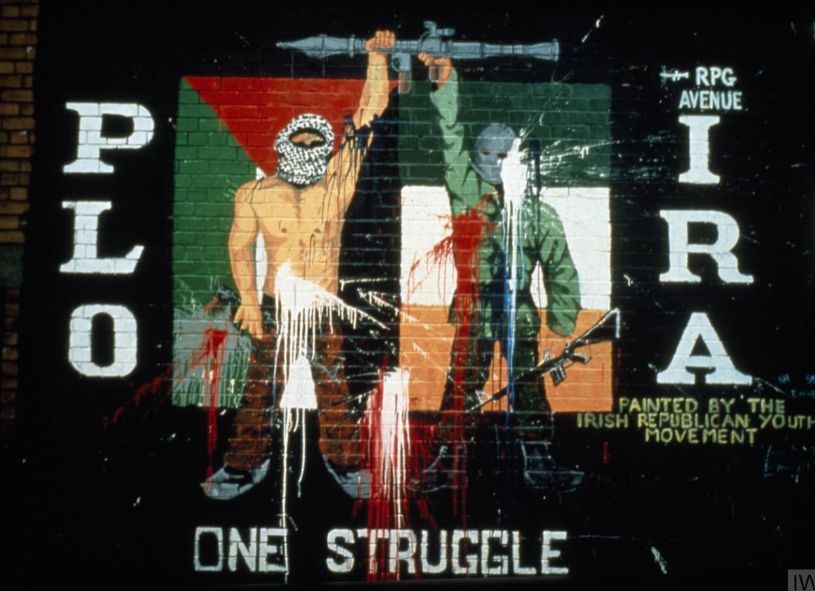
Ireland is part of a minority of Western nations that have been vocal in their support for Palestine over the previous two years. Indeed, public support for Gaza is widespread in the country, for several reasons. Connections between Palestine’s nationalist movement and Irelands are well known. The PLO and IRA murals can still be seen in Northern Ireland today. However, less nationalistic Irish people who may hate the IRA and its legacy are still usually sympathetic to Gazans. They may see Irish history as sharing similarities with that of Palestine. Both countries have been colonies of the United Kingdom and have experienced settler colonialism. Albeit Palestine is currently being subjected to this in the West Bank, whereas for Ireland it is in our distant past. For others, supporting Palestine is simply an obvious stand to have if one believes in international law and/or basic moral principles. It is not a position grounded in nationalism but in the present conditions Palestinians live under.
Regardless, the overwhelming public sympathy puts the Irish government in an awkward position. They obviously want to cater to voters and be seen to be upholding international law, which many do genuinely believe in, but must balance this with other factors.
In 2018 a bill was created in Irelands parliament called the occupied territories bill. If passed, it would outlaw trade with illegally established settlements in occupied territories. Those found to have breached the law would be punished by a 250,000 euro fine and up to five years in prison. This bill would not just apply to the West Bank, but any illegally occupied territory in the world. Eastern Ukraine, Western Sahara and Northern Cyprus come to mind.
Still, the implications were clearly negative for Israels settlement program in the West Bank. Soon after it passed the second stage in Parliament in 2019, a letter was received by the Irish government from the United States. Ten members of the U.S congress threatened that the bill, if implemented, would create potentially severe implications for Ireland economy. Ireland also received similar letters for state representatives who threatened negative repercussions for Irish workers in the United States. It was soon shelved by Ireland thereafter.
The bill soon saw renewed interested in October 2023 when Hamas launched the largest attack on Israel since 1973. Israels response, which has been labelled a genocide by a UN commission of inquiry, saw a new wave of voices in Ireland demand the bill be passed into law. The Irish government once again promised to do so, and once again received threats from the United States.
In 2025 the US State department commented directly:
“This legislation is unhelpful virtue signalling. It does not serve the cause of peace in the Middle East, which the US and partners are advancing … and could moreover adversely affect American businesses operating in Ireland. We are monitoring developments closely.” Additionally, several months previously, the US Ambassador to Ireland emailed the government warning of “consequences” and “unforeseen economic uncertainty” should the bill pass and advising them to conduct “due diligence.”
According to The Ditch, 90 minutes later Micheal Martin decided the bill would be reviewed rather than passed immediately. Weeks later, the bill was watered down to include goods but not services, which accounts for only 30% of Irish trade with the Occupied Territories. The Irish government still claim that it will soon be made into law.
An incredible moment from this whole debacle was Mike Huckabees reaction to the bill. For those who don’t know, Huckabee is the US ambassador to Israel. In July, he reacted to Irelands OTB with a racist remark about alcoholism. “Did the Irish fall into a vat of Guinness?” he wrote on twitter. This was obviously poorly received in Ireland.
What all of this has shown is that while Ireland is vocal in support of Palestine, it does not follow up its own words with actions. While symbolic, albeit still important, steps such as recognising Palestine have been taken, it is difficult for Ireland to take more concrete steps. Why is this? Because the Irish economy relies on the United States, a situation of our own making and entirely unrelated to Israel. No anti-Semitic conspiracies in my comment section please. Ireland’s fiscal watchdog estimates that 75% of all corporate tax is paid by large U.S. multinationals, with three firms responsible for almost 40% alone.
According to Reuters, this has transformed Irelands public finances into one of the healthiest in Europe. US dominated multi nationals also employ 11% of Irelands workforce. In an era where Trump is demanding US companies to return to the United States, and tariffing his allies and foes alike, Ireland is in a vulnerable position. If that remains the case, Irelands hand will continue to be limited when it comes to Palestine. Maintaining good relations with the United States will usually come first. It is a case of national interest over taking values. It is also in the interest of Irelands governing parties too. If they bring on an economic downturn how will that be received by their voters in the next election?
So, what is to be done? Well, diversifying our economy away from the United States is the obvious choice. But this is easier said than done, and it’s a slow process at that. It might even be forced on Ireland if Trumps trade wars take off again. In that situation, Ireland would have to either adapt quickly or end up in an economic crisis. For the foreseeable future Ireland will be where it currently is, comically reliant on a handful of multinationals and unwilling or unable to take concrete steps away from it. The price for this will be hypocrisy on its stance on Palestine. Words are cheap, actions are expensive.
Sources
Gritten, David. 2025 “Israel has committed genocide in Gaza, UN commission of inquiry says.” BBC, September 26 ( https://www.bbc.co.uk/news/articles/c8641wv0n4go).
Leahy, Pat. 2025. “US government labels Occupied Territories Bill ‘virtue signalling” Reuters. November, 24 (https://www.irishtimes.com/politics/2025/11/24/us-government-labels-occupied-territories-bill-virtue-signalling/).
Reuters. 2025. “What is Ireland’s exposure to the US economy and Trump’s plans?” March 11, (https://www.reuters.com/en/what-is-irelands-exposure-us-economy-trumps-plans-2025-03-11/).
Sabbagh, Dan. 2025. “Israel closes down or leaves unresolved 88% of cases of alleged war crimes or abuse – report.” The Guardian, August 2 (https://www.theguardian.com/world/2025/aug/02/idf-no-fault-conclusion-alleged-war-abuse-cases-report).
The Ditch. 2024. “US ambassador warned of ‘consequences’ for enacting Occupied Territories Bill – 90 minutes later Micheál Martin said it would be reviewed rather than passed.” November 5, (https://www.ontheditch.com/us-ambassador-warned/).
The Journal. 2019. “Government told that Occupied Territories Bill could affect immigration status of Irish in US.” May 17, ( https://www.thejournal.ie/occupied-territories-bill-irish-immigrants-usa-4638016-May2019/).
 Every Clime, Class and Colour