Why Ireland Is Hypocritical on Palestine
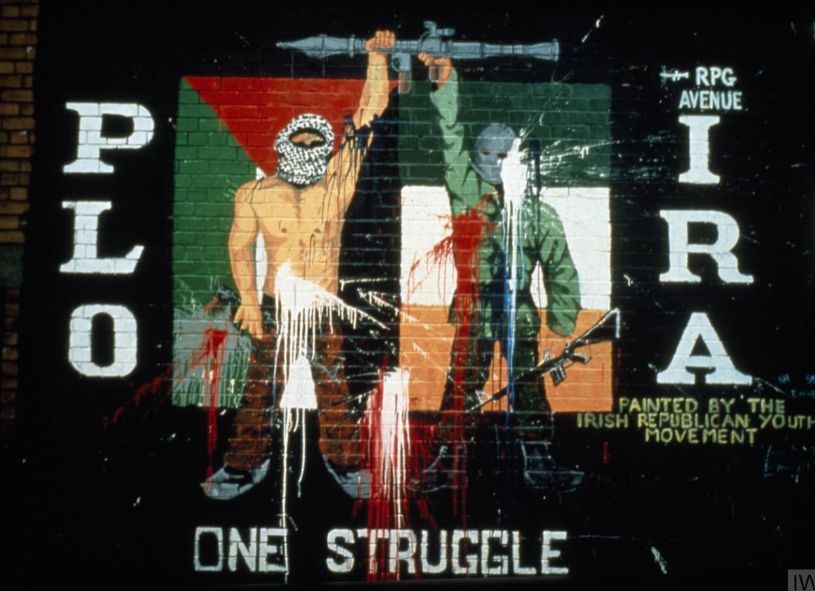
Ireland is part of a minority of Western nations that have been vocal in their support for Palestine over the previous two years. Indeed, public support for Gaza is widespread in the country, for several reasons. Connections between Palestine’s nationalist movement and Irelands are well known. The PLO and IRA murals can still be seen in Northern Ireland today. However, less nationalistic Irish people who may hate the IRA and its legacy are still usually sympathetic to Gazans. They may see Irish history as sharing similarities with that of Palestine. Both countries have been colonies of the United Kingdom and have experienced settler colonialism. Albeit Palestine is currently being subjected to this in the West Bank, whereas for Ireland it is in our distant past. For others, supporting Palestine is simply an obvious stand to have if one believes in international law and/or basic moral principles. It is not a position grounded in nationalism but in the present conditions Palestinians live under.
Regardless, the overwhelming public sympathy puts the Irish government in an awkward position. They obviously want to cater to voters and be seen to be upholding international law, which many do genuinely believe in, but must balance this with other factors.
In 2018 a bill was created in Irelands parliament called the occupied territories bill. If passed, it would outlaw trade with illegally established settlements in occupied territories. Those found to have breached the law would be punished by a 250,000 euro fine and up to five years in prison. This bill would not just apply to the West Bank, but any illegally occupied territory in the world. Eastern Ukraine, Western Sahara and Northern Cyprus come to mind.
Still, the implications were clearly negative for Israels settlement program in the West Bank. Soon after it passed the second stage in Parliament in 2019, a letter was received by the Irish government from the United States. Ten members of the U.S congress threatened that the bill, if implemented, would create potentially severe implications for Ireland economy. Ireland also received similar letters for state representatives who threatened negative repercussions for Irish workers in the United States. It was soon shelved by Ireland thereafter.
The bill soon saw renewed interested in October 2023 when Hamas launched the largest attack on Israel since 1973. Israels response, which has been labelled a genocide by a UN commission of inquiry, saw a new wave of voices in Ireland demand the bill be passed into law. The Irish government once again promised to do so, and once again received threats from the United States.
In 2025 the US State department commented directly:
“This legislation is unhelpful virtue signalling. It does not serve the cause of peace in the Middle East, which the US and partners are advancing … and could moreover adversely affect American businesses operating in Ireland. We are monitoring developments closely.” Additionally, several months previously, the US Ambassador to Ireland emailed the government warning of “consequences” and “unforeseen economic uncertainty” should the bill pass and advising them to conduct “due diligence.”
According to The Ditch, 90 minutes later Micheal Martin decided the bill would be reviewed rather than passed immediately. Weeks later, the bill was watered down to include goods but not services, which accounts for only 30% of Irish trade with the Occupied Territories. The Irish government still claim that it will soon be made into law.
An incredible moment from this whole debacle was Mike Huckabees reaction to the bill. For those who don’t know, Huckabee is the US ambassador to Israel. In July, he reacted to Irelands OTB with a racist remark about alcoholism. “Did the Irish fall into a vat of Guinness?” he wrote on twitter. This was obviously poorly received in Ireland.
What all of this has shown is that while Ireland is vocal in support of Palestine, it does not follow up its own words with actions. While symbolic, albeit still important, steps such as recognising Palestine have been taken, it is difficult for Ireland to take more concrete steps. Why is this? Because the Irish economy relies on the United States, a situation of our own making and entirely unrelated to Israel. No anti-Semitic conspiracies in my comment section please. Ireland’s fiscal watchdog estimates that 75% of all corporate tax is paid by large U.S. multinationals, with three firms responsible for almost 40% alone.
According to Reuters, this has transformed Irelands public finances into one of the healthiest in Europe. US dominated multi nationals also employ 11% of Irelands workforce. In an era where Trump is demanding US companies to return to the United States, and tariffing his allies and foes alike, Ireland is in a vulnerable position. If that remains the case, Irelands hand will continue to be limited when it comes to Palestine. Maintaining good relations with the United States will usually come first. It is a case of national interest over taking values. It is also in the interest of Irelands governing parties too. If they bring on an economic downturn how will that be received by their voters in the next election?
So, what is to be done? Well, diversifying our economy away from the United States is the obvious choice. But this is easier said than done, and it’s a slow process at that. It might even be forced on Ireland if Trumps trade wars take off again. In that situation, Ireland would have to either adapt quickly or end up in an economic crisis. For the foreseeable future Ireland will be where it currently is, comically reliant on a handful of multinationals and unwilling or unable to take concrete steps away from it. The price for this will be hypocrisy on its stance on Palestine. Words are cheap, actions are expensive.
Sources
Gritten, David. 2025 “Israel has committed genocide in Gaza, UN commission of inquiry says.” BBC, September 26 ( https://www.bbc.co.uk/news/articles/c8641wv0n4go).
Leahy, Pat. 2025. “US government labels Occupied Territories Bill ‘virtue signalling” Reuters. November, 24 (https://www.irishtimes.com/politics/2025/11/24/us-government-labels-occupied-territories-bill-virtue-signalling/).
Reuters. 2025. “What is Ireland’s exposure to the US economy and Trump’s plans?” March 11, (https://www.reuters.com/en/what-is-irelands-exposure-us-economy-trumps-plans-2025-03-11/).
Sabbagh, Dan. 2025. “Israel closes down or leaves unresolved 88% of cases of alleged war crimes or abuse – report.” The Guardian, August 2 (https://www.theguardian.com/world/2025/aug/02/idf-no-fault-conclusion-alleged-war-abuse-cases-report).
The Ditch. 2024. “US ambassador warned of ‘consequences’ for enacting Occupied Territories Bill – 90 minutes later Micheál Martin said it would be reviewed rather than passed.” November 5, (https://www.ontheditch.com/us-ambassador-warned/).
The Journal. 2019. “Government told that Occupied Territories Bill could affect immigration status of Irish in US.” May 17, ( https://www.thejournal.ie/occupied-territories-bill-irish-immigrants-usa-4638016-May2019/).
Tom Barry: British Soldier Turned IRA Guerilla
Tom Barry was Irelands most successful IRA leader during the Irish War of Independence, which took place between 1919 and 1921. Leading a mobile column of men that never numbered more than 100, his exploits fighting the British Army and the RIC have entered legend. Using Guerilla tactics, he claimed to have killed over 100 British soldiers in the space of a year, not including police or informers who he routinely had executed. His most famous ambush at Kilmichael killed 16 men. Barry’s side lost only 2. He later wrote of this period:
They said I was ruthless, daring, savage, blood thirsty, even heartless. The clergy called me and my comrades murderers; but the British were met with their own weapons. They had gone in the mire to destroy us and our nation and down after them we had to go.
But before joining the IRA, he ironically began his military career in the British Army. Today I am going to focus on this career as well as his early years growing up in County Cork.
Early Years
Barry was born on the 1st of July 1897 in Rosscarberry, West Cork. He was the second son amongst 11 children. His father, Thomas worked for the RIC, the police force of Ireland at the time. This was the force that Barry would later lead a guerrilla campaign against. Leaving school aged 17 he worked as a clerk for a merchant in Bandon, before joining the British Army in 1915 after lying about his age. According to Barry, he joined the army for the following reasons:
In June, in my seventeenth year, I had decided to see what this Great War was like. I cannot plead I went on the advice of John Redmond or any other politician, that if we fought for the British we would secure Home Rule for Ireland, nor can I say I understood what Home Rule meant. I was not influenced by the lurid appeal to fight to save Belgium or small nations. I knew nothing about nations, large or small. I went to the war for no other reason than that I wanted to see what war was like, to get a gun, to see new countries and to feel a grown man. Above all, I went because I knew no Irish history and had no national consciousness.
WW1
Barry joined the Royal Field Artillery and served in both Egypt and Iraq, where he saw combat against the Ottoman Empire. His first taste of fighting was in the failed attempt to relieve the Siege of Kut in Mesopotamia. The war there was different to Europe. The heat, floods, disease and the mobile nature of the campaign all combined for a different albeit till brutal experience. The casualty rates the British took in battles here were comparable to the western front. Barry saw heavy fighting in this doomed relief attempt. The British took 23,000 casualties and had their greatest loss of the three-year campaign. It was also here, 12 miles from Kut, that he heard about the Easter Rising in Dublin. It was according to Barry a rude awakening.
He later participated in several British victories at the Hai salient, Falluja and Baquba where the Turks and British clashed in trench fighting. This was part of the broader Samarra offensive in 1917 which ended in victory but at the cost of 18,000 British casualties. By 1918, two years after his arrival in Iraq, he and his division had forced the Turks up the Tigris Valley in a series of engagements. During his service he was mentioned in dispatches but was also punished several times for small offences. This include being late for parade and being disrespectful to NCOs. His division was later sent to the Palestine front in 1918, now in its closing phases. Barry however remained in Egypt until 1919 which was the logistical hub of the fight in Palestine.
1919
Barry returned to Ireland in 1919 and was discharged from the army with a positive reference: his papers noted that he was a “good hardworking man.” He received a disability pension in May for malaria and a heart issue. It is unclear of this referred to PTSD or an actual heart disorder, but he was hospitalised in 1920 and 1922 for heart problems which likely confirms the latter. It is curious that within a year of his return Barry would kill nearly 20 fellow army veterans at kilmichael, nor did he ever express remorse for it.
“I was the first Army officer to tackle the dreaded Auxiliaries at Kilmichael and I smashed their power and broke forever the morale of those mercenaries who were especially enlisted for their fighting qualifications and their bloodthirstiness. I did it with twenty two riflemen not one of whom had ever fired a shot in action previously… I left eighteen of them [the Auxiliaries] dead…and burned their lorries. And their comrades never waited for us once after that’.
He applied for a British civil service job in 1919 and served as secretary of the ex-servicemen’s association. He later claimed he was infiltrating it to supply the IRA with intelligence, but other IRA veterans later said this was untrue. Some factors that may have led him to join the IRA include a beating he received from the British in late 1919 and the murder of his friend John Bourke by the British Army. Bourke was also a fellow veteran, and Barry was his honour guard at his funeral under his position as secretary of the ex-servicemen’s association. Whatever the reason for his change of heart, the IRA was initially suspicious of Barry due to his background and only allowed him to join with caution. Fortunately for them, he excelled in his post and quickly became leader of his soon infamous flying column.
In another post I will focus on his IRA career, but I first wanted to highlight his background which was not unusual for the time. Several army veterans joined the IRA and proved to be useful due to their combat experience and knowledge of the British Military. Still, it is a deep irony that the Greatest IRA commander of the period would break his teeth in a British War far, far from home.
Sources
Barry, Tom. 1981. Guerilla days in Ireland. Dublin: Anvil Books.
Dorney, John. 2020. “Tom Barry and the Road from Mesopotamia to Kilmichael.” The Irish Story, December 4 (https://www.theirishstory.com/2020/12/04/tom-barry-and-the-road-from-mesopotamia-to-kilmichael/).
Hopkinson, M. 2009. “Barry, Thomas Bernadine.” Dictionary of Irish Bibliography, October (https://www.dib.ie/biography/barry-thomas-bernadine-tom-a0472).
McLoughlin, Mark. 2008. “Tom Barry: guerrilla days in Iraq.” History Ireland (https://historyireland.com/tom-barry-guerrilla-days-in-iraq/).
Wilcox, Ron. 2006. Battles on the Tigris: The Mesopotamian Campaign of the First World War. Pen and Sword Books: Barnsley.
Charles Trevelyan’s Political Beliefs
Two centuries after The Irish Potato Famine Charles Trevelyan name still conjures much distaste in Ireland. Whether in Eavans Bolands poem The Famine Road or Pete St Johns the Fields of Athenry he is not immortalised kindly. Usually, his name is used as a target for Irish hostility towards British rule and mismanagement. This is quite understandable given he was the head of the British funding for aid relief in Ireland from 1845 until the end of the Famine.
However, as if often the case the truth is more complicated. This video will focus on Trevelyan’s own history of the Famine, written in 1850. Like all histories it is biased in that his environment shaped his view and attitude towards the famine and with it the narrative of the text. But the text does reflect both his political and social views, which is the focus for today’s video. His motivation for the writing will also be laid out. But first we must discuss his life before he became Assistant Treasurer of the United Kingdom.
Life
Trevelyan’s background was one to be expected for a man of his status. Born into a family of nine in 1807 he was the fourth son of Ven. George Trevelyan. Trevelyan senior was a protestant Minister and the 4th Baronet of Nettlecombe, with these lands being in the family since 1452.[1] He had a successful career in the Anglican church becoming Archdeacon for his home in Tauton, England. His wife Harriet Neave was a daughter of a wealthy merchant Richard Neave who also had a successful career as a governor of the Bank of England. As such Trevelyan junior was born into a wealthy and well-connected family, being exposed to both religion and politics at a young age.
He was well educated and soon began a career in the British Civil Service in India. He soon gained a reputation for being hard on corruption, bringing his superior officer to justice on such charges. This and his skill for languages caused him to quickly rise through the ranks of the East India Company. During his time in India, he successfully campaigning for greater educational rights for Native Indians. His account on the topic entitled On the Education of the People of India (1938) documents this period.
The Irish Crisis
Returning later to Britain he continued his civil service career and was the highest-ranking servant at the outbreak of the Famine in 1845 as Assistant Secretary to the Treasury.[2] This put him as the third most powerful government official at the time and he would hold this post until 1850. As such he was involved in Famine relief for Ireland throughout the period, serving under two Cabinets. During those years he also released his work The Irish Crisis which documents his work and opinions on the disaster. His work is of course quite valuable as a source for historians and has been much studied.
The work also serves as a good insight into how Trevelyan viewed the world. His goal when writing the novel (first published by chapter in the British newspapers) was multifaced. He claims he wrote it to document the Famine for future generations to understand what had occurred.[3] As we have seen he did this previously at other times in his career. But the reader cannot help but notice he also wrote it to defend himself and the government’s actions during the period. As such the work could also be seen as politically motivated. He gives a robust defence of the government policy and even claims the Famine relief was successful. But 1.1 million deaths speak of a different story.
A colonial attitude
Regardless, it gives a unique insight into his social and political outlook when discussing religion, economics, and Ireland as a whole. While Ireland had been a part of the United Kingdom all his life Trevelyan inherited arguably a colonial mindset when it came to Ireland. Perhaps as a symptom of being from a well-established family or from his experience as a colonial official in India, he at times held a dismissive tone when discussing Ireland. On the mere second page of the Irish Crisis he writes, “what hope is there for a nation who lives on potatoes?”. [4]
This of course lays the blame on the Irish people for the severity of the Famine instead of poor British policy. His tendency to write in such a manner reflects that he was a product of his time. Many British politicians blamed Ireland for its troubles to absolve themselves of responsibility for its ills. Some even go so far as blaming the morality of the Irish people. For example, in 1846 The Economist blamed the Irish for the famine as it was “brought on by their own wickedness and folly”.[5] Trevelyan’s writings did not fully escape this trope.
Racism
However, Trevelyan did not write in a racial way about the Irish people unlike some of his peers. He never strays into making remarks on the failures of the Irish character but rather complains about how inefficient the agricultural industry was. Some historians such as Robert Haines have argued that Trevelyan’s focus of frustration was towards the land holding classes, not the predominantly Irish catholic tenants.[6] While praising some pro-active landlords in The Irish Crisis, he wrote that “others have been guilty of that entire abandonment of duty which has brought reproach upon their order. For the future this cannot be”.[7]Such landlords were usually from British ancestry themselves.
Perhaps his lack of racial prejudice is a result of his progressive political views for the time or his fondness for collecting Irish paraphernalia helped him avoid such a bias. Ironically for an English civil servant, he was an avid collector of Irish nationalist pamphlets. More likely his lack of an openly racist view was caused by his Whig tendencies. The Whigs were the precursor to the modern Labour party and took up progressive causes during Trevelyan life. His sincere progressive beliefs seem to have kept him from adopting a more racial tone that his Tory counterparts. But he certainly held a common (for his station) Britain- centric view when discussing Ireland.
Laisser-faire economics
A second continuing theme in Trevelyan writing is his staunch belief in laisser-faire economics. During his lifetime the world saw the birth of capitalism, especially in Britain during the early 19th century. Government intervention in the markets was seen as a poor idea. Rather the view that the market is a force that would correct itself if left alone was mainstream amongst Trevelyan and his peers in government. This attitude impacted both his response to the Famine and how he wrote about the topic. For example, the victims of the Famine are not mentioned but rather the economic ramification of their deaths are. He never once gives a human face to the suffering that occurred.
He viewed the Famine as paving a new opportunity to improve the country economically by becoming closer to Britain. He viewed it as his job to shift Ireland from a subsistence economy to one of agricultural capitalism.[8] He even concludes The Irish Crisis with a hope that God may bless the generation “in which this great opportunity has been offered.”[9] Besides the severe lack of compassion shown this also tells us that he truly was sincere in his economic beliefs. He viewed the Famine largely as an economic and agricultural problem, not a human one.
Religious views
As stated previously Trevelyan had a religious upbringing through his father. This is also reflected in The Irish Crisis. He, and many of his contemporaries, viewed the Famine as an act of God. In the Irish Crisis he refers to it as a “Direct stroke of an all-wise and all-merciful Providence.”[10] This was a common way of viewing the Great Hunger especially from devout British Protestants in England but also a times from Irish Catholics too. Trevelyan did not go as far as some of his peers in this view, however. The more extreme end believed the Famine was a punishment for Irelands immorality. In other words, they brought a racial element into their view. Trevelyan, as a loather of sectarianism and with a genuine interest in Ireland, stopped short of this extreme narrative. Once again, his Whig tendencies maybe have helped him moderated his view although this has not stopped his vilification. Many of the supposed racist remarks made by Trevelyan has been misattributed to him which has been abused by some historians. In no part of his writings does he use religion as a vehicle for prejudice.
Conclusion
So, what exactly could a reader perceive Charles Trevelyan political and social out look to be based on these writings? Broadly speaking Trevelyan had a similar view to many of his peers in England. An almost spiritual belief in laisser-faire economics certainly. A veteran of the East India Company it is understandable that he approached the issue of the Famine with such a mindset. And the lack of compassion shown towards the lower classes can be traced to this adherence to free trade. Interlinked with this was his belief in God. A member of the Anglican Church, he like many of his colleagues viewed the world through a religious framework. He believed that God could directly cause such a catastrophise as the Famine for a higher purpose.
But he differed from some in that due to a lack of sectarianism he did not hold prejudice for other denominations. He did however view Ireland in a disconnected way like many of his countrymen in a manner that could be described as colonial. This is not surprising for a civil servant of the British Empire. This view also likely originates also from his time in India as part of the colonial administration. In his account of his struggle for educational rights for Indians, On the Education of the People of India, he compares Ireland (and Wales) to India when discussing the teaching of English to foreign speaking peoples.[11]
What he will always be immortalised for however is as the man in charge of the Civil Service of the United Kingdom while 1.1 million of its citizens died from starvation and disease.
Bibliography
Primary sources
Gutenberg. (ed.) The Irish Crisis, (Edinburgh, 1848).
The Economist, 10 October 1846.
Trevelyan, Charles. On The Education of The People Of India, (London, 1838).
Secondary sources
Boylan, Ciara. ‘Charles Trevelyan and the great Irish Famine.’ Book Reviews, XIII (2005) p1.
Gillissen, Christopher. “Charles Trevelyan, John Mitchel and the historiography of the Great Famine”, Revue Française de Civilisation Britannique, XIX-2 (2014) pp. 195-21.
Haines, Robin. Dictionary of Irish Biography, ‘Trevelyan, Sir Charles Edward’ (https://www.dib.ie/biography/trevelyan-sir-charles-edward-a8647) (October 2009).
Leazer, J. ‘Politics as Usual: Charles Edward Trevelyan and the Irish and Scottish Fisheries before and during the Great Famine.’ Irish Economics and Social History XLIX (2022) pp 47-59.
[1] Christopher Gillissen, “Charles Trevelyan, John Mitchel and the historiography of the Great Famine”, Revue Française de Civilisation Britannique, XIX-2 (2014) p 195.
[2] Robin Haines. Dictionary of Irish Biography, ‘Trevelyan, Sir Charles Edward’ (https://www.dib.ie/biography/trevelyan-sir-charles-edward-a8647) (October 2009).
[3] Gutenberg (ed.). The Irish Crisis (Edinburgh,1848) p 1.
[4] Gutenberg (ed.). The Irish Crisis p 2.
[5] The Economist, 10 October 1846.
[6] Ciara Boylan. ‘Charles Trevelyan and the great Irish Famine.’ Book Reviews, XIII (2005) p 1.
[7] Gutenberg (ed.). The Irish Crisis p 159.
[8] J Leazer ‘Politics as Usual: Charles Edward Trevelyan and the Irish and Scottish Fisheries before and during the Great Famine.’ Irish Economics and Social History XLIX (2022) p 3.
[9] Gutenberg (ed.). The Irish Crisis p 201.
[10] Gutenberg (ed.). The Irish Crisis p 201.
[11] Charles Trevelyan. On The Education of The People Of India, (London, 1838) p 220.
John Mitchel: Driving A Wise Man Mad
Background
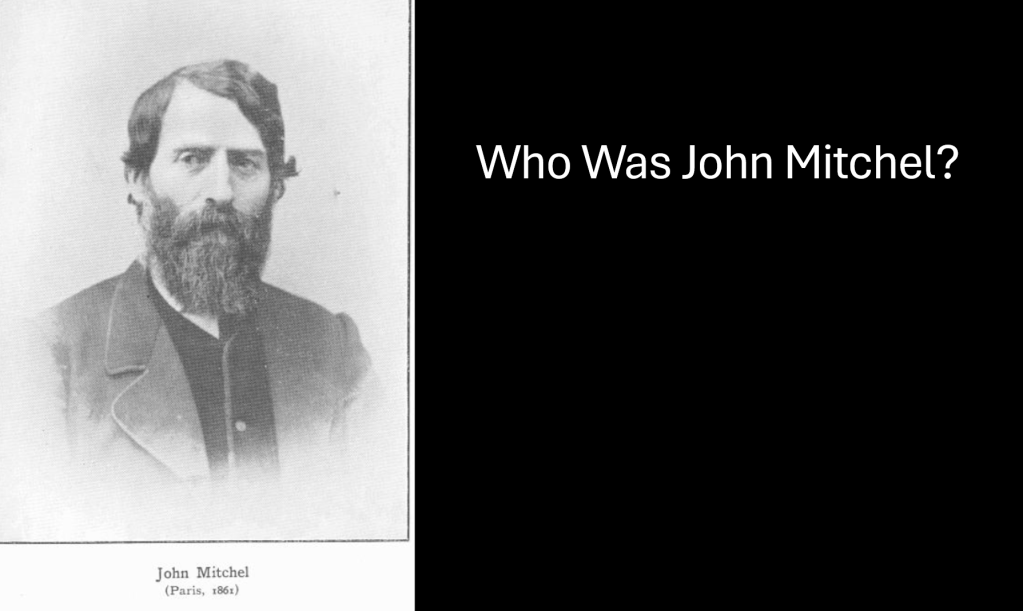
Mitchel was born in Derry, Ireland in 1815 to a presbyterian minister also named John and his wife, Mary. Mitchel Senior rose to become presbyterian synod of Ulster when his son was seven but later became a focal unitarian. As to be expected Mitchel Juniors youth was steeped in religion and but later opposed all religious beliefs while studying at Trinity University.[1] After finishing his legal studies he quickly founded a practice in 1839 instead of following his father into the ministry. Through his practice he developed a nationalist attitude due to his increasing frustration over the discrimination of Catholics by Protestant magistrate. In the 1840s he became an avid writer for various nationalist newspapers and joined the militant Young Irelanders movement. He founded a newspaper himself titled the United Irishman which expressed a radical nationalist viewpoint. His writings with the Nation and United Irishman were influential with Irish historian F.S Lyons referring to Mitchel as one of the most effective journalists that century.[2] His increasingly militant writings eventually resulted in his arrested and deportation to penal colonies in Bermuda and later, Australia. His arrest was met by indignance in Ireland and contributed to the failed 1848 skirmishes of the Young Irelander Rebellion.
Early Years
Mitchell early years was marked by religious and political tension which was shared by many across Europe during those years. 1848 was a year of widespread revolution in Europe due in part to the rise of nationalism. Irelands situation at the time was one of outrage which worked as a catalyst to radicalise Mitchell and other physical force republicans. As such not only was Mitchel a writer of the Famine, but he was also a firsthand survivor and a victim of penal labour. Both these ordeals hardened his nationalist sentiment. His world and its events were interpreted by him with a hatred of the British Empire. This is entirely understandable viewpoint given his experiences. To him, he had lost years of his life incarcerated for the “Cause of ‘civilisation’ and of British Law and Order.”[3] He would write a memoir known as the Jail journal of his experiences in prison which he used railed against the Empire. It was received positively and became an influential book for Irish Nationalists the profits of which helped fund a new life for him in the United States. He continued his nationalist activities amongst the Irish American communities there until his death in 1875. As such his entire life was dominated by the national struggle, always surrounding himself with likeminded people of a similar background as he. Even his cellmate in Australia was a fellow Irish nationalist.[4]
Hatred of Modernity
As much as Mitchel believed in Irish nationalism, he had an equally strong hatred of the modern world. As a thinker he disregarded the Enlightenment and remarked in an 1854 speech that social progress was impossible.[5] The enlightened nationalism of Wolfe Tone to him was wrong. Rather he believed in a pre-industrial society made of farmers free for any form of government interference. As early as the 1840s Mitchel also expressed a hatred for modern capitalism and landlordism in the United Irishman.[6] Britain with their industrialised and commercialised empire represented the exact opposite of Mitchel’s social beliefs which contributed to his Anglophobia. But he was not a socialist, rather an extreme social conservative/revolutionary who despised leftist ideals. This along with his sense of nationalism formed Mitchel’s perception of the world. For example, he viewed the North – South divide in the United States as one between a capitalist industrial North and a free agrarian South. As such he supported the Southern States secession from the Union. Irelands relationship with Britain was the same struggle against the industrialised world. He even once claimed that compared to the “dark satanic mills” of industrialised Britain Southern chattel slavery was more humane.[7] This view would leave a stain on Mitchel’s legacy and complicates his commemoration as an influential rebel to this day.
The Last Conquest of Ireland
It was there in the United States that he began his work on The Last Conquest of Ireland (perhaps) that would become synonymous with the Famine. It was also during this time that Mitchel became an advocate for chattel slavery. He was an avid supporter for the Southern cause citing them as victims of the Northern states, just like Ireland was a victim of Britain. He even moved to Knoxville Tennessee and in 1857 began publishing the newspaper Southern Citizen to promote these views. It was in the same paper that he first published The Last Conquest of Ireland (perhaps) in 1858, eventually publishing it in book form in 1860.[8] It would become as well-known as his previous Jail Journal and would further ensure Mitchel’s contribution to Irish nationalism. The following year the United States Civil War would break out and Mitchel as well as his three sons would enlist in the Confederate Army. All seeing extensive service Mitchel would lose two sons in the War.[9] His third was also badly wounded in the conflict and his daughter would die of natural causes during the same period. After the war he continued his work with the Fenians and write extensively about Ireland. He would return to Ireland to be elected to a parliamentary seat in Tipperary before dying nine days later in 1875 and was laid to rest in Newry.[10]
Legacy
His legacy would consist of his writings, which continues to draw readers in the present day. Mitchel’s motives for his most famous work The Last Conquest of Ireland (perhaps) were of course heavily political. Fuelled by just anger at the British government the book is a political accusation as much as it is a history of the Famine. It is more rightly characterised as a Polemic work shaped by Mitchel’s worldviews. The work interprets the Famine as an intentional attempt by the British government to thin out Irelands population. In part he argued this was to clear land in Ireland to grow food for the growing industrialised population in England. This argument was first expressed by Mitchel in his writings during the Famine itself as he, in his own words, witnessed things that would have “driven a wise man mad”.[11] Mitchell’s argument has been rebuffed by modern historians but continues to be a common narrative amongst Irish nationalists. Mitchel’s view that while the blight did come naturally it was the English who created the Famine has nevertheless become a political slogan. In a sense this has proved to be successful in its purpose as a political charge as the work would radicalise and be prime motivation to further generations of Irish nationalists. Patrick Pearse was one such man and would label Mitchel’s Jail Journal “‘the last of the four gospels of the New Testament of Irish nationality, the last and the fieriest and the most sublime’.[12]
Bibliography
Primary Sources
Mitchel, John. The last conquest of Ireland (perhaps) (1861)
Mitchel, John. Jail Journal
Secondary Sources
Lyons, FS. Ireland Since the Famine (London, 1971).
Ó Cathaoir, B. ‘Mitchel Politicised the Famine’ Seanchas Ardmhacha: Journal of the Armagh Diocesan Historical Society, XX (2005) pp 155–162.
Quinn, James. Dictionary of Irish Bibliography, ‘Mitchel, John’ (https://www.dib.ie/biography/mitchel-john-a5834) (October 2009).
Russell, Anthony. ‘John Mitchel—flawed hero,’ 18th-19th Century history, XXIV (2016) p 1.
[1] James Quinn. Dictionary of Irish Bibliography, ‘Mitchel, John’ (https://www.dib.ie/biography/mitchel-john-a5834) (October 2009).
[2] FS L Lyons, Ireland Since the Famine (London, 1971) p 98.
[3] John Mitchell Jail Journal (1854).
[4] B. Ó Cathaoir ‘Mitchel Politicised the Famine’ Seanchas Ardmhacha: Journal of the Armagh Diocesan Historical Society, XX (2005) p 155.
[5] Anthony Rusell ‘John Mitchel—flawed hero,’ 18th-19th Century history, XXIV (2016) p1.
[6] Dictionary of Irish Bibliography, ‘Mitchel, John’ (https://www.dib.ie/biography/mitchel-john-a5834).
[7] Ó Cathaoir ‘Mitchel Politicised the Famine’, p 161.
[8] Dictionary of Irish Bibliography, ‘Mitchel, John’ (https://www.dib.ie/biography/mitchel-john-a5834).
[9] Rusell ‘John Mitchel—flawed hero,’ p1.
[10] Ó Cathaoir ‘Mitchel Politicised the Famine’, p 162.
[11] Mitchel, Jail Journal (1854).
[12] Rusell ‘John Mitchel—flawed hero’ p1.
County Clare And Its Importance In The Irish War of Independence
Before the official outbreak of hostilities in 1919, County Clare was an ethnically and religiously homogeneous County, with a population of around 200,000 people. Over 98% were Catholic with the remaining 2 per cent or 2,000 people being Protestant as of 1911.[1] The County was predominantly rural, with 90% of its population living in rural areas, not towns. As is the case in many rural areas during this period, most of the workforce was set in agriculture. In fact, high grain prices during the 1910’s saw somewhat of a renaissance for owners of farms who benefited from the Great War’s demand for food. Still much of the population lived in poverty as labourers. Those who could not find work emigrated, usually to the United States of America. Incredibly, during this period, over 1/3 of County Clare was able to speak Irish, meaning that many people would have had a bilingual life. Very few would have spoken Irish as their sole language.
The County had a long tradition of nationalist politics, with the Home Rulers drawing much support. In Fact, Willie Redmond, brother of John Redmond, represented the East Clare constituency, until he was killed in action in 1917. Michael Brennan was considered as a candidate for the following by-election, but Eamon De Velera was chosen instead and won by a landslide. His victory was totalled at 5,000 votes compared to the IPP’s (Irish Parliamentary Party) only 2,000 votes.[2] This signalled a large shift in Clare politics, from parliamentary nationalism to a more radical form, represented by De Valera. What had long been a solid seat for Redmondite had now been roundly rejected by the public sentiment. The people of the county became more militant gradually towards the British administration. This usually expressed itself in the form of cattle drives, and illegal re distribution of land to poor farmers. The practice became increasingly common in the years between 1916-1919 and helped keep militant nationalism active in the County.
When the official conflict began, County Clare proved to be an important theatre during the War of Independence for the British, but also, especially for the Republican movement. The County was one of the first to see a Guerrilla campaign begin against the RIC, and later against the British Army. The first attack on police occurred as early as March 1917, just weeks after the Clare Brigades of the Irish Volunteers (later the IRA) was established. The first fatality however, occurred a year later, in February of 1918, when police opened fire on cattle run, and killed an IRA volunteer named John Ryan. On the centenary of his death, Ryan was recognised as the first Clare casualty of the War of Independence.[3] This further escalated in the 1918-1919 period, when the East Clare Brigade launched several attacks on police huts and on RUC patrols. The first fatality inflicted by the emerging Guerrilla campaign occurred in August of 1919, in which an RIC member was killed. These attacks while usually limited in its success, were significant enough for Piaras Beaslai to remark “it was really in Co. Clare that the guerrilla war may be said to have started.”[4]
County Clare was also the first County to use the flying column patrols, that have become notorious within that period of history. The Flying columns were bands of IRA fighters, numbering no more than a few dozen, who ate, slept, and fought together. They were continually mobile, never staying in the same place for a long period of time and launching attacks where possible. According to Michael Brennan, the tactic developed organically in County Clare, with men who on the run from the authorities decided to group together.[5] This started with a group of 3-4 fugitives, before ballooning to over 20 people in the East Clare Brigade area. This tactic was success for the Clare IRA as well, and it was soon adopted in surrounding counties. The leadership in Dublin would go on to officially recommended the creation of a Flying Column in each Brigade area, throughout the country, in August of 1920.[6]
The IRA in County Clare was at first incredibly disorganized. This was due in large part to the constant bickering within the organization. The three families of the Barrett’s, Brennans and O’Donnell’s all fought for control of the IRA within the County. Their ambitiousness led to frequent arguments, resulting in Headquarters in Dublin getting involved. They eventually agreed on splitting the IRA into 3 Brigades giving 1 Brigade to each family. This was not universally appreciated by those in East Clare, such as Patrick and Michael Brennan, who wanted a divisional command over the entire County. In Fact, Michael Collins believed that Patrick specifically held a “hell of a grievance” towards him for the move.[7] But it was eventually accepted by all families and provided stability of leadership in the County in which a Guerilla campaign was able to be launched. The East Clare Brigade were particularly active in the fight against informers, carrying out 6 out of 7 executions against spies in the whole of County Clare during the period. The six men executed were a mixture of British soldiers, Black and Tans, as well as two civilians. The execution came over a year after the Brigades August 1919, declaration that all informers will be “shot on sight.”[8]
[1] David Fitzpatrick, Politics and Irish Life 1913-21: Provincial Experiences of War and Revolution, prologue xii.
[2] The Irish Times (12 July 1917).
[3] Mc Gann, Colin. ‘Commemoration for Volunteer John Ryan.’ (https://clarechampion.ie/commemoration-for-volunteer-john-ryan/) (February 23, 2018).
[4] Fitzpatrick, Politics, and Irish Life 1913-21: Provincial Experiences of War and Revolution p 225.
[5] Brennan, Michael., The War in Clare 1913-1921 (Four Courts, 1980) p 70.
[6] Fitzpatrick, Politics, and Irish Life 1913-21: Provincial Experiences of War and Revolution p 217.
[7] Fitzpatrick, Politics, and Irish Life 1913-21: Provincial Experiences of War and Revolution p 207.
[8] Clare Museum, Proclamation from the Clare IRA against informers, 8 August 1919.
The Incredible Life of Sean Mac Bride
Sean Mac Bride
Sean Mac Bride had a distinctly unusual life. Born in Paris in 1904 to Irish parents, he moved to Ireland after his father’s execution there in the aftermath of the 1916 Easter Rising. The rebellion was launched against British rule in Ireland and marked the beginning of the Irish Revolution. Unsurprisingly, he quickly became engaged in nationalist politics when arriving in Ireland which culminated in him joining the Irish Republican Army. At the time, the IRA was engaged in a guerrilla war which would last over two years (1919-1921). It was quickly followed by a civil war (1922-1923) which saw Mac Bride join the losing side and spending much of the conflict imprisoned by the Irish government. He continued opposing the Irish state after escaping from prison and became a close friend of Eamonn De Velera who would go on to be Taoiseach (Prime Minister) and President of Ireland. All of this occurred when Mac Bride was still in his teens.
He remained active in the IRA for years after, briefly becoming Chief of Staff of the IRA in 1936 while also earning a law degree. During these years he was again arrested and imprisoned for murder but was acquitted. He eventually put the gun aside, resigning from the IRA and beginning a political career as leader of a political Party named Clann na Poblachata or Family of the Republic in 1946(Keane, 2009). The party had brief but limited success becoming part of a governing coalition after WW2. While an elected politician he continued to be sympathetic to the IRA as a campaigner for the rights of political prisoners in Ireland. He eventually lost his seat in the 1957 elections and his party dissolved soon after. He did not resign from politics, however. His legal and political career throughout his life extended far beyond Ireland. Starting from the 1940s he began a career as a Human rights campaigner and peace activist internationally. This part of his career is what this essay will focus on as it highlights many trends that occurred across Europe and the globe following the aftershocks of WW2. He was involved in everything from decolonisation, European integration and Cold War politics often having paradoxical political views.
Through his appointment as minister for external affairs in 1948 he was appointment as vice president of the OEEC or the Organisation of European Economic Cooperation. This organisation was created to help run the Marshall plan which rebuilt Europe after the war with American aid. He was also a signatory in many major international accords most notable the European Convention on Human Rights and the Geneva convention for the Protection of war victims (History Ireland, 2006). The integration of Europe into one economic block had begun and Mac bride was at the centre of it. This would eventually lead to the development of the EEC and European Union in which he was a strong supporter of. During this time his also paradoxically was key in preventing Irish membership of NATO. This was because in many Irish citizens view Northern Ireland was still illegally occupied by Britain. To this day Ireland is part of only a handful of western European nations not to be a member. While only holding his ministerial role for three years mac Bride managed to create a name for himself which he would use to launch a career in the United Nations and in the field of human rights.
His U.N career would begin after his stint as Minister from external affairs and would last till his death in the 1980s. Most of his work focused on newly emerging states in Africa where he was held in high esteem by activist there, especially in South Africa. This is because Mac Bride’s father raised an Irish brigade of volunteers 300 strong and fought in the Boer War against British rule in the region at the turn of the century (History Ireland, 2000). This gave him a unique in with the apartheid government. A staunch opponent of apartheid he led efforts to have it abolished, including supporting an Irish boycott of South African goods in the 1980s. This was a significant protest movement in Ireland during the time which saw a significant surging of support for equality in South Africa. This in turn gained him respect in the eyes of the ANC who stated after his death in 1988 “our debt to him can never be repaid” (History Ireland, 2006).
His work in Africa also brought him to Nigeria where in 1960 he helped write Nigeria’s first constitution. The country was the first African British colony to be granted independence which one can imagine felt quite good for Mac Bride. He went on to also help in the creation of Ghana’s, Zambia’s, and Tanzania’s first constitution. One this was accomplished he stayed as an advisor for the head of states of these countries. Together with African leaders he also created the Organisation for African Unity, now known as the African Union. He also played an extensive role in Namibia’s history. In 1973 he was made United Nations Commissioner for Namibia with rank of Assistant Secretary-General of the United Nations which he held until 1977 (Abraham, 1997). Namibia was then occupied by South Africa which was under pressure by the UN to withdraw and allow free elections for the country. His status with the South African government allowed him to make headway for eventual Namibian independence, which unfortunately he would not see before his death.
Mac Bride also worked outside government institutions to further human rights protection. In 1961 he co-founded Amnesty International which to this day is not tied to any one state but rather has maintained its independence. He remained in Amnesty until 1975 and his work with the organization was one of the main reasons, he was awarded the Nobel Peace Prize in 1974. He was the first Irishman to receive such an award. Three years later he was awarded the Lenin Peace Prize by the Soviet Union who had a positive view of Mac bride due to his criticisms of the United States during the Cold War. However, in his native Ireland Sean Mac Bride is not well remembered or commemorated. Perhaps he is eclipsed by his father’s legacy as a martyr for Irish Republicanism. Or perhaps the lack of awareness surrounding Sean’s international career reflects Irelands unique ability (in 20th century Europe) to constantly look inward. Perhaps our neutrality during WW2 has led to a lack of knowledge of European integration and the development of the United Nations. Certainly, our lack of colonies has made de colonisation in Africa rather obscure, at least outside Irish Republican circles. Regardless of who remembers, it can be said that Sean Mac Bride was a major figure in post war Europe politics for over thirty years. His career encompassed most of the major political developments which occurred in his lifetime. His politics was international, he saw beyond his own borders and attempted to help create a more equitable world out of the ashes of the World War.
Bibliography
History Ireland (2006, July). Sean Mac Bride and Namibia. History Ireland, https://www.historyireland.com/sean-macbride-and-namibia/.
History Ireland (2000, Spring). MacBride’s Brigade in the Anglo-Boer War, History Ireland https://www.historyireland.com/macbrides-brigade-in-the-anglo-boer-war/.
Irwin Abrams. (1997). Nobel Lectures, Peace 1971-1980 (1st Edition) Frängsmyr.
Keane, Ronan. (2009, October). Mac Bride, Sean. DIB. https://www.dib.ie/biography/macbride-sean-a5109.
Why Ireland Should Take Maritime Security in its Sea’s Seriously.
Irelands territorial waters is significantly larger than its landmass. Covering an area of 880,000 km squared, it is more than 10 times the size of the Island itself. However, most Irish people are not aware of this. Irish politics features limited discussions on how to utilise this asset, and why it’s necessary to be able to defend it. The Irish Sea’s is important for many reasons. Irelands economy is reliant on telecommunications cables from the USA that pass through Irish waters. If several of them were damaged the economic consequences could be severe. The Irish Sea is also important for our fisheries who are hurt by illegal fishing practice by international trawlers. The sea is also key to completing the transition to renewables that climate change demands. It is in Irelands interest to take each of these issues seriously. More discussion around this topic needs to appear in the Islands political discourse. To that end, this blog will first discuss the current state of the Irish Navy and then why Maritime security is key for Ireland to prosper.
The Irish Naval Service
The current situation with the Irish Navy is poor. For an island nation, Irelands Naval capacity is extremely limited. The Naval Service currently has just over 700 personnel and is currently operating only one ship capable of patrolling the Atlantic (O’Riordan, 2024). There are a further two ships operational but are not fit for Atlantic conditions. The minimum number of personnel advised is over 1,000 meaning it is significantly understaffed. The government has made some positive steps to address this. In 2024 wages were increased for serving personnel who will now receive 20,000 euro more than in 2023 (Parente, 2024). This has been done to attract new recruits as well as retain current members. It is too soon to tell if this will have the intended effect so for now the staff shortage remains. The Navy has had some success with humanitarian missions in recent years in a variety of regions around the world. However, with the current shortages it is unable to properly patrol and monitor Irelands territorial waters. This neglect is a result of various governments inaction over many years. It also reflects the apathy regarding the defence issues more broadly. But the development of the Navy is important for the following reasons.
Smuggling and Illegal Fishing
This limited capacity for patrolling’s Irelands territorial waters means that the country is attractive to smugglers. In recent years there has been several high-profile cases of drug smuggling in Irish waters, likely coming from South America. While Ireland has fortunately begun to take a more health-based policy approach to drug addiction, smuggling represents a significant revenue source for Irish gangs. The poor security capacity also affects the states’ ability to crack down on illegal fishing. This is especially true regarding foreign supertrawlers. This issue has been brought up in the Dail just this year following allegations from whistleblowers in the fisheries enforcement sector that Dutch trawlers were illegally fishing ((Mc Bride, 2024). There is a large perception amongst Irish fishermen that supertrawlers often overfish and endanger Irish fishermen’s livelihoods. This has been a significant issue for decades, ever since Ireland joined the EEC (now EU). The fisheries are often regarded as one of the few losers in Ireland joining the European community. And with the severely limited naval presence in the seas, the issue is harder to prevent.
Underwater Cables
Ireland is an important position regarding transatlantic telecommunications cables between Europe and the United State. 75% of all cables in the Northern hemisphere pass through or are near Irelands territorial waters (Mc Cabe and Flynn, 2023). Having the ability to protect these cables is vital for both the Irish economy and Europe’s. This is especially true since the start of the Ukraine war which has seen several underwater pipelines in the Baltics sabotaged. Early in the Ukraine war the Russian Navy planned to hold a training practice in Irelands EEZ, close to the cables. While they eventually cancelled these plans the stunt did highlight how unequipped Ireland is to monitor the cables. Ireland does not have an agency dedicated to protecting undersea infrastructure. Rather, five separate government departments as well as private companies and state agencies cover it collectively (Mc Cabe and Flynn, 2023). This has led to fractured policy decisions and is reflective of how little interest the state has had in developing maritime security. While a deliberate attack on the infrastructure is unlikely it is not impossible, and Ireland should strive to develop its maritime security. This could be done without changing its policy surrounding neutrality, which should be seen as a separate issue.
Energy Security and Renewables
Ireland is also in a fragile situation with its energy security. Over 70% of the energy Ireland consumes is imported, significantly higher than the EU average of 58% (Lee, 2022). Most of this is oil and gas and comes to Ireland through sea pipelines from the UK. Only a small amount is produced by Ireland from the Corrib gas field off the West Coast. At a time when sea pipelines are blowing up across the Baltic Sea, this dependence on imports should be reduced. This is already being done with ambitious plans from the government to develop the renewables sector through wind projects in the Irish Sea. There has also been a large increase in energy being generate through solar panel farms across the country. This scheme allows farmers to rent their land to the government for a period of 20 years and so far, has been a success. However, as of 2022 only 13% of Irelands energy needs have been met by renewables (Lee, 2022). Gas and oil are still overwhelmingly relied on. Ireland should dramatically scale up its development of its Sea’s as an energy source. Both through Wind turbines and possibly if it is worthwhile, waves. Irelands coastline provides the perfect conditions for both renewables and would provide greater diversification of energy sources.
An important prerequisite for this is again for Ireland to develop its naval capacities to monitor and defend its sea-based energy resources. However, it is also true for renewables that will soon be transported to Ireland through underwater cables. For example, Ireland will soon be connected to the French electricity grid through a subsea power cable that is due to finish by 2027. It will provide enough electricity to power 500,000 homes (Irish Independent, 2024). It will be renewable because France gets most of its energy needs through nuclear power. Although producing nuclear power is illegal in Ireland since 1999 consuming energy generated by it is not. While this is quite ironic, it also shows how even the transition to renewables will still in part rely on underwater transportation in Ireland for years to come. The importance of developing the Navy and its underwater monitoring abilities will remain. An improved Navy would help in the defence of Irelands fisheries, cables and energy resources. The country can only benefit.
Bibliography
Irish Independent. 2024. “Editorial: Why choosing to import nuclear power is a typically Irish solution.” Irish Independent, January 8. Retrieved November 13, 2024 (https://www.independent.ie/opinion/editorial/editorial-why-choosing-to-import-nuclear-power-is-a-typically-irish-solution/a1638823886.html).
Lee, George. 2022. “At a glance: Where does Ireland’s energy come from?” RTE, September 6. Retrieved November 13, 2024 (https://www.rte.ie/news/environment/2022/0907/1320733-where-does-irelands-energy-come-from/).
Mc Bride, Oliver. 2024. ” Whistleblower Claims Foreign Supertrawlers are Pillaging Irish Waters.” The Fishing Daily, July 3. Retrieved November 8, 2024 (https://thefishingdaily.com/featured-news/whistleblower-claims-foreign-supertrawlers-are-pillaging-irish-waters/).
McCabe, R., & Flynn, B. 2023. “Under the radar: Ireland, maritime security capacity, and the governance of subsea infrastructure.” European Security, 33: 324–344.
O’Riordan, Sean. “Irish navy is now at two thirds of its full strength.” Irish Examiner, June 23. Retrieved November 8, 2024 (https://www.irishexaminer.com/news/arid-41421892.htmlhttps://www.irishexaminer.com/news/arid-41421892.html).
Parente, Giovanni. 2024. “Will new pay measures help retention in the Irish Naval Service?” RTE, January 12. Retrieved November 11, 2024 (https://www.rte.ie/brainstorm/2024/0112/1426020-irish-naval-service-personnel-retention-crisis-salaries-humanitarian-missions/).
 Every Clime, Class and Colour