Why Trump Wants Greenland | The Death of NATO
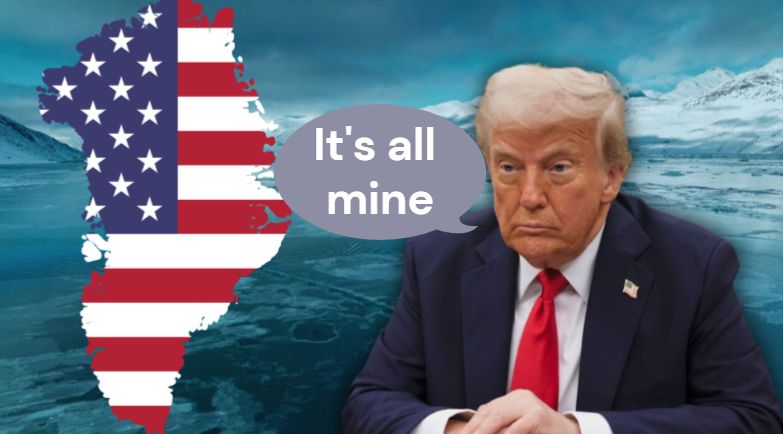
For over a century the United States has been interested in acquiring Greenland. Usually this was under the idea that it would be purchased from Denmark, to which Greenland is a part. The issue was revived during Trumps first term but amounted to nothing. Greenlanders have zero interest in becoming a part of the United States. And Denmark also. Since Trump was elected for the second time in 2024, he has moved from the idea of purchasing Greenland to simply annexing it. Now with the capture of Maduro this remote possibility is looking more likely. He has once again renewed his threats towards the icy island, much to the frustration of Europe.
Why Greenland?
But why Greenland? With a population of 56,000 people, it seems an unlikely target for the United States. The reasons are twofold. First, mineral wealth. According to the United States government, there are 50 minerals considered critical for their economy and armed forces. Most are currently supplied by China. Greenland has known reserves of 43 out of the 50 minerals. This makes Greenland lucrative for the United States government; in a way no other place is. Despite the wealth, Greenland struggles to exploit their resources due to a lack of labour. Just 0.2% of Greenlanders are unemployed. There are worries that bringing in foreign labourers would shift the demographics in a way that makes the population uncomfortable. Just one hypothetical mine would need a workforce of 300. This alone would increase the population by 0.5%. Even applying to set up a new mine is slow. The licensing department that approves new mining ventures and other economic projects has just 16 people. Investors end up waiting years just for their application to be reviewed. Trump probably thinks the only way to get the resources he wants is to simply take over the country. He is hardly known for his patience.
Trump also wants to annex a sovereign country because of Greenland’s strategic location. According to the Arctic Institute:
“The advent of climate change has brought about a number of different changes in the Arctic, including increased accessibility to Arctic ports as well as the opening of new Arctic shipping lanes. With new trans-Arctic routes, including the Northern Sea Route (NSR) and the Northwest Passage (NWP), as well as newly built and refurbished ports from Russia, political and military interests are reevaluating the region as one of geopolitical competition.”
Due to Greenland’s position in the Arctic circles, it has becoming more geopolitically important in an increasingly competitive region. Its worth pointing out however that Greenland already holds several US bases and it a part of NATO. So, Trump really doesn’t need to annex it to benefit from its location. It doesn’t really make much sense. Perhaps he just believes everything in the Western Hemisphere should belong to the United States. The Donroe Doctrine.
What Would Happen?
So, what would happen if Trump did annex Greenland? How exactly the annexation would be done is unclear. Regime change and replacing their government with a puppet US one is possible. I don’t think Greenland would be integrated into the United States. Annexation would immediately trigger a crisis inside NATO. The largest member of the alliance would be invading another. The country that created and protected the alliance for 80 years would overnight become a threat. Worst case scenario, NATO would effectively die. What would this mean for Europe? It is unlikely the rest of NATO would militarily oppose the United States. They wouldn’t recognise the annexation and would show support for Denmark’s territorial integrity. But for the most part, there’s not much they can do. A trade war between the US and EU is possible. Sanctions seem incredibly unlikely.
Europe would be forced to make some sort of replacement for NATO through the EU. Even an EU army wouldn’t be far fetched in such a scenario, though it would take years to materialise. With the death of NATO, a security vacuum would have to be filled, especially to deter Russia. Moscow would also make a move if Trump did indeed take Greenland. It is possible Putin would annex Svalbard in the Arctic, a group of Norwegian islands, for similar geopolitical reasons. It has a population of only 3,000, meaning Europe may not go to war over it. A less likely possibility is Russia moves into continental Europe with NATO gone. But they are bogged down in Ukraine and may not have the ability to wage a second war. And if Russia moved westward on the continent, say in the Baltics, a war would certainly happen.
Conclusion
As you can probably tell from these hypotheticals, a US invasion would be catastrophic for Europe. It would end an 80-year relationship and usher in a new era of US – European relations. One filled with fear, uncertainty and war.
It is worth noting something that is often lost in discussions around Greenland, and that is the self determination of its people. Greenland was colonised by Denmark centuries ago and its natives underwent a similar treatment that natives received in Canada and the United States. While no longer a colony (it is an autonomous region of the Kingdom) Greenland has an active independence movement that seeks to break with Denmark. The recent threats from the United States have damaged this movement, making it less likely that it succeeds. Trump has effectively pushed them closer to Denmark. At the end of the day, it is the people of Greenland that should choose the Islands future. Not Trump and not Denmark. Their self determination would be the first casualty of a US invasion.
Sources
Bryant, Miranda. 2026. “Trump must give up ‘fantasies about annexation’, says Greenland’s PM.” The Guardian, January 5 (https://www.theguardian.com/world/2026/jan/05/trump-must-give-up-fantasies-about-annexation-says-greenland-pm).
Gricius, Gabriella. 2021 “Geopolitical Implications of New Arctic Shipping Lanes.” The Arctic Institute, March 18 (https://www.thearcticinstitute.org/geopolitical-implications-arctic-shipping-lanes/).
The Economist. 2025. “American threats push Greenland closer to Denmark.” The Economist, May 19 (https://www.economist.com/europe/2025/05/19/american-threats-push-greenland-closer-to-denmark).
The Economist. 2024. “Greenland faces one of history’s great resource rushes—and curses.” The Economist, October 31 (https://www.economist.com/finance-and-economics/2024/10/31/greenland-faces-one-of-historys-great-resource-rushes-and-curses).
Why the United Nations Security Council Needs Reform
Reforming the UNSC
The United Nations Security Council is the most powerful organ of the United Nations. All matters relating to security is brought through this council. It has five permanent members: France, United Kingdom, United States of America, Russia and China. They gained these seats as the victors of the Second World War. The council also has 10 elected members, serving two-year terms. This undemocratic arrangement is made worse by the five permanent members holding veto power over any issue. Even if four out of five nations agree on a policy, the fifth can override the decision. This means that any UN peacekeeping mission must be agreed on unanimously, if it is to come into effect. Geopolitics, and national interests must align amongst the five for this to happen. The veto power has been abused since the creation of the council with the two biggest offenders being Russia and the United States. The Cold war is filled with instances of one of these major powers putting their own interests above those of the UN. For the first 25 years of the rivalry, Russia was the main abuser, with the United States of America rarely utilising it. This flipped towards the end of the Cold War. In the 1985-1990 period, for instance, the United States of America used their veto 27 times while the Soviets none. (Kennedy, 2007). To make matters worse, the veto power has been used outside of security matters in which it was intended to be used exclusively for. Membership applications, appointments of UN officials also face the possibility of a veto.
This has proved embarrassing for the UN as a whole and has repeatedly undermined the public’s faith in the institution. Even now, the United States of America has been repeatedly vetoing any motions on the Israel-Palestine conflict, and Russia is doing the same for the Ukraine War. These power games have made it so that UN Peacekeeping Operations are usually only passed for regions where there are no clashing strategic interests of the big five. Regions in which there is a clash, and Peacekeeping may be needed the most, are often left to boil over. Some of the bloodiest Cold War conflicts occurred in situations where a big five member felt threatened. There was no role for the UN in the Vietnam conflict, because of the United States of America, or in the Cambodian Civil War and Genocide, because of China (Kennedy, 2007). But that has not stopped the UN from working when they are permitted. Since Peacekeeping began in 1948, there has been over 70 missions throughout the globe, with 12 currently ongoing missions. The earliest interventions were in interstate conflicts with clear objectives. This, then shifted towards deployments, within the context of civil wars, making the missions more complex and difficult (Jett, 2019). This followed the global trend of a declining number of state-on-state wars, and an increase in civil ones.
Still, power games played through the UNSC by permanent member states are arguably one of the biggest challenges facing Peacekeeping as a whole. It is also one that is deeply rooted in the design of the UN. The UNSC permanent members gained their place as major powers in the 1945 landscape, but this balance of power has been shifting. There are now over three times more States in the world, than in 1945, and some are on track to become major powers. To accommodate this change, reform to the SC has been a topic of discussion. Expanding both the permanent members and non-permanent members is often suggested. Japan and Germany are often cited as contenders as the second and third largest funders of the UN (Kennedy, 2007). India, with its population of 1.6 billion people, is hard to ignore, as well as the fact that South America and Africa have no current permanent seats between them. An expanded UNSC would bring greater representation, and a wider focus on security issues globally. The ideal reform, however, would be the removal of the veto, and simply have a majority rules voting system. This is unlikely to happen, as the big five could threaten to leave the UN over such reform. While frustrating to would be reformers, it is important to note that without the veto, these countries may not have bought in to the idea of the UN in 1945.
The national interest of these five nations will likely continue to influence which UN missions are passed, and if they are a success or failure. It has been broadly agreed however, that any new permanent members added in the future would not have veto power (Black, 2008). A recent push for reform in 2005, saw Brazil, India, Japan and Germany as the main contenders to an expanded council. In total, the 15 members would be increased to 25. This push failed, but the debate has not ended. An expanded UNSC would allow a broader debate on when, and if, a peacekeeping mission should be pursued. With the world becoming increasingly multipolar, the UN must include these growing powers in this discussion. If they continue to be excluded, the UNSC could become increasingly irrelevant, and their resolutions ignored. This, ironically, would not be in the interest of the big five as their privileged position would lose meaning. It would also be catastrophic for the UN overall, jeopardising the existence of peacekeeping missions. Reform, would likely come slowly, piece by piece, as is typical for changes at any level of the UN. But, without change, the future peacekeeping missions will be unrepresentative of world opinion and increasingly seen as irrelevant.
Bibliography
Black, Maggie. 2008. The No-Nonsense Guide to the United Nations. Oxford: New Internationalist.
Jett, Dennis C. 2019. Why Peacekeeping Fails: 20th Anniversary Edition. London: Palgrave MacMillan.
Kennedy, Paul. 2006. The Parliament of Man. London: Penguin Books.
Karl Polanyi’s Market Society.
The term market society is often associated with the works of Hungarian economist Karl Polanyi. Born in Vienna in 1886 Polanyi spent his life studying various human economies throughout history. His most well-known work The Great Transformation (1944) focuses on the impact of post industrialised market economies and more specifically on its impact on the shaping of human society. This book coined both the term market society and double movement. Double movement referred to the simultaneous expansion of self-regulating markets and the movement to protect people from its effects (Dale, 2008). The term market society differs from the often-heard phrase market economy which is often defined by reference to either a free capitalist market or State Capitalist. The U.S is an example of a nation dominated by free market thought while the Soviet Union embodied the latter. It differs as it does not just refer to the exchange of goods and services within a society but puts an emphasis on how the market shapes human relations between peoples. For Polanyi who was heavily critical of 20th century capitalism, a Market Society refers to a society in which “instead of economy being embedded in social relations, social relations are embedded in the economic system” (Polanyi, 1944). A market society develops by commodifying three core roots of social life: land, labour, and money. This market society is one that devastates environment habitats and the communities of people within it.
The result is what we see all around the world today. Society is often subservient to the self-regulating market system. This has been remedied somewhat and to different extents with the emergence of the welfare state. But Polanyi argued that a market society is one in which would eventually destroy the society itself. In other words, it is unsustainable. It does damage in various ways. Firstly, the environmental degradation is the easiest to visualise for contemporary readers. The depletion of the planet’s resources and the annihilations of various forms of life in the process of this depletion is embodied in Climate Change. In the views of Fraiser (2014) the second is a shadow economy of papers values that while insubstantial Is able to devastate the ‘real’ economy. This can be seen in the perpetual boom bust cycle the world has been stuck in for the last two centuries. The impact of economic crashes can destroy millions of lives overnight. Historical examples such as the 2008 financial crisis or the 1929 Wall Street crash still permeate through public memory. Thirdly, a market society damages itself by straining human relations between peoples. Our ability to cooperate with each other and to build communities come under threat (Fraiser, 2014). This can be seen in the loneliness experienced by those excluded by society such as the unhoused. In an era dominated by criticisms of capitalisms environmental impact, Polanyi’s concept of a market society remains useful 80 years after it was written. But it remains removed from mainstream economists who still prefer a more orthodox views of market economies.
Bibliography
Dale, Gareth (2008). “Karl Polanyi’s The Great Transformation: Perverse effects, protectionism, and Gemeinschaft,” Economy and Society, Vol. 37, No. 4, 495–524.
Fraser, Nancy (2014) “Can society be commodities all the way down? Post-Polanyian reflections on capitalist crisis,” Economy and Society, 43:4, 541-558.
Polanyi, Karl. 1944. The Great Transformation. New York: Farrar & Rinehart.
The World Is A Mess, But Not Inherently
The World Is A Mess, But Not Inherently
The world right now feels chaotic. Maybe it often has been, but we are simply more aware of it in the modern age. Regardless, the war in Ukraine and Palestine threaten to spill into regional ones. The UN is at a standstill due to lack of funding. The United States seems to be heading towards a recession, threatening their neighbours with annexation on the way down. Underpinning all of this is the looming threat of climate change. It is easy to fall into nihilism when facing so many problems. In such scenarios it is common for people to talk as if conflict is part of human nature. Of course we will have another world war because we have already had two. It is part of who we are, why fight it? I argue because becoming apathetic and Darwinian is a surefire way of ensuring the situation will continue to worsen. On that note, today I am going to talk about an article first published in 1940 named Warfare is Only an Invention — Not a Biological Necessity.
I initially believed that war developed out of agricultural society. Settled communities at some stage in pre-history used their surplus of food and wealth to wage the first war. I presumed that to have been inevitable. Once the material conditions arose that could support a war effort, wars we had. Extreme violence has been a part of the human experience since the dawn of time. Even Neanderthals may have in part been driven to extinction by Homo Sapiens once we arrived at Europe (Gilpin, Meldman and Aoki, 2015). However, Mead’s article Warfare is Only an Invention — Not a Biological Necessity changed how I conceptualised the start of warfare. She argued that the rise of warfare (and the continuation of it in the modern era) was/is not inevitable. Rather, it is a social invention that developed in some cultures and not in others. Inuit of North America she argued, never developed the concept of war until relatively recent times. This differed from similarly advanced society of the Pygmies in Africa, who routinely engaged in warfare throughout history (Mead, 1940). And if warfare is something that has been invented, perhaps it could be replaced in the future with something that is less destructive.
This must have been comforting for Mead as WW2 had just broken out in the time of her writing. Her theory on pygmies and Inuit’s may be incorrect. Perhaps some preserved Inuit’s will be found with wounds from a battle and war did come to the Inuit’s sooner than we think. But I think it is important to keep the overall idea from Mead in mind. War is a social invention, the same as marriage and taxes, and perhaps can be changed by the societies of the future. It is easy to think of war as part of human nature and therefore inevitable. This can lead to apathy and in the worst case excuse the brutality that is carried out in war. But if we conceptualise war as distinct from nature, as something that comes about not because of our biology, then it is something we can change. It’s when we accept something as inevitable that we give up on ever trying to adjust the direction we are going in. We become lethargic individuals with no agency and that’s not how people with integrity act. At a time where liberal institutions such as the United Nations is under attack from those who shun multilateralism, this becomes important. Neither the Israeli conflict nor the Russian invasion of Ukraine was inevitable, and neither are future wars.
A better future is always possible.
Bibliography
Gilpin, W, Meldman, M.W and Aoki, K. 2016. “An ecocultural model predicts Neanderthal extinction through competition with modern humans.” Proc. Natl. Acad. Sci. U.S.A. 113: 2134-2139.
Mead, Margaret. “Warfare is Only an Invention — Not a Biological Necessity.” In The Dolphin Reader. 2nd edition. Ed. Douglas Hunt. Boston: Houghton Mifflin Company, 1990. 415-421.
 Every Clime, Class and Colour