Park Chung Hee: A Revolutionary Tyrant

Who was Park?
Park Chung Hee was the most consequential leader of South Korea in its 80-year history. Born in 1917 to a poor rural family in Gumi when the country was a colony of Japan, his prospects as a young adult was limited. Like many men of his generation, he would go on to join the Japanese Army where he was trained in Manchuria and Tokyo. There he adopted an affinity for Japan and its Meiji restoration.
When World War Two ended he joined the newly created South Korean Army where he was given further training. Despite his pro Japanese past, in 1946 he joined the Korean Workers Party. He was later arrested for this and came close to being killed. Instead, he continued his career in the army and fought in the Korean War for the South.
His post war career saw him rise to the top of the South Korean Army, leaving him in an influential position which he used to his advantage in the 1960s.
Authoritarianism
In 1961 after just a year of democratic rule following Symen Rhee’s exile, Park instigated a bloodless military coup. This ushered in 18 years of uninterrupted rule by Park, where he led at varying times as a civilian albeit authoritarian president and as a full-blown military dictator.
His most infamous creation as leader was the Korean Central Intelligence Agency, or KCIA. It quickly became the most feared organisation in the country and became notorious for murdering, kidnapping and torturing of his political opponents. Along with the military it was also used routinely to crack down on protests and strikes.
As a now militant anti-communist, he was widely supported by the United State who appreciated South Koreas deployment of troops to Vietnam in 1964. Parks grip on the country reached new heights during the 1970s. The KCIA was given a wider leash to crack down on his opponents. Descent was met with violence. In August 1973 opposition leader Kim Daejung was kidnapped by Park and taken out on a fishing boat to be drowned. He was only spared when a Japanese plane flew directly over the ship as a warning. By intervention of the Us Ambassador and Japanese, his life was spared. Most were not so lucky.
In 1974 Parks wife was shot dead by a bullet meant for him. He grew more isolated and increasingly unpopular. Something had to change and indeed it did. In 1979 Park was shot dead by his close friend Kim Jaegyu, the director of the KCIA, while having dinner. His 18 years of rule was over. But despite his violent rule two million Koreans attended his funeral, many genuinely mournful. Why? Because of the Miracle on the Han River.
Miracle on the Han River
Following the Korean was the country was incredibly poor. In fact, it was one of the poorest countries in the world. Park changed this. He brought in reforms which fuelled industrialisation. The nation underwent what is known as compressed development. In barely three decades South Koreas economy developed at a rate which took western countries 1 to 2 hundred years to accomplish. Between 1963 and 1979 the GDP rate grew by 10% per year. This became known as the miracle on the Han River, after the body of water that flows through Seoul.
Imagine being a born a peasant on a farm your parents rented from a local landlord. You are illiterate and your parents have always struggled to feed you. You live through Japan’s colonisation, WW2 and the Korean War by the time you are 20. By the time you are fifty you live in a modern apartment with appliances such as a tv and fridge. You eat three times a day, as does your children. You have a decent job at a local factory, albeit you work long hours. If you are lucky, you may be saving some money to go on a holiday. That radical change was experienced by millions of Koreans under Parks dictatorship.
While development created new social problems for many, nobody could doubt that Park had improved the country by the time of his death.
Contested Legacy
Parks legacy is complicated, naturally so given the circumstances. He was a brutal dictator and an economic revolutionary. Because of his reforms South Korea Is now one of the wealthiest nations on earth. But he also oppressed his own people to get there, and his authoritarian governance led to brutal crackdowns on Korea’s democracy movement. His popularity was sufficient for his daughter to be elected President in 2013. Park geun Hye as she is known received most of her support from Koreas Elderly. They remembered her father’s rule and how it changed the country.
Parks story is a reminder of the complexities of leaders and how they can improve or devastate their people’s lives.
Sources
Cha, Victor D and Pardao, Ramon P. 2023. Korea: A New History of South and North. Yale University Press: New Haven.
Pardo, Ramon. 2022. Shrimp to Whale: South Korea from the Forgotten War to K-POP. C. Hurst& Co: London.
Hwang, Kyung Moon. 2001. A History of Korea. Bloomsbury: London.
Peter, A. M. 2012. Democratisation and National Development: A Comparative Analysis of Nigeria and South Korea, 1999 to 2009. (https://www.researchgate.net/publication/320347170_DEMOCRATISATION_AND_NATIONAL_DEVELOPMENT_A_COMPARATIVE_ANALYSIS_OF_NIGERIA_AND_SOUTH_KOREA).
Why North Korea Is Not A Communist State

It is quite popular to characterise North Korea as the last communist state, a Stalinist relic of the cold war. Certainly, the country was created by the USSR following the end of World War Two, and the state developed along the lines of many other communist states. It is hard to pinpoint when North Korea began to shift away from Marxist Leninism, and it is equally hard to determine if the Norths ruling class every took it as a guiding ideology. What I am sure of is that today’s North Korea certainly has no interest in it. Today’s video is going to discuss why, focusing on three characteristics of the state: Militarism, Racial Nationalism and Hereditary Leadership.
Hereditary Leadership
To start, North Korea functions as something close to a monarchy. The Kim family has ruled the country since at least the 1960s through a cult of personality with Kim Il Sung at the centre. In turn he groomed his son to be his successor which was successfully accomplished in the 1990s. Kim Jong Il ruled until his passing in the late 2000s, followed by his son Kim Jong Un. While many communist countries were dictatorships like the USSR or Mao’s China, communist states shunned such hereditary leadership. In fact, Kim Il Sung’s insistence on his son continuing his rule reportedly annoyed his allies in the CCP.
The Cult of personality surrounding the Kim family also frustrated the post Stalinist USSR. Some individual communists even considered a hereditary system to be akin to an absolute monarchy. No state in the communist world to my knowledge has ever had three generations of rulers from the same family. It is likely impossible for a North Korean to even imagine a future leader of a country that is not a Kim. Today it is still a custom in the North to have three portraits in your home: that of Kim Il Sung, Kim Jong Il and Kim Jong Un. The book Nothing to Envy even claims that it was a legal requirement in the 1990s.

Militarism
North Korea is the most militarized nation on earth with a mandatory service of 10 years for men. However, many men serve anywhere between 3 and 12. Because of this, North Korea has the third largest army in the world number 1.3 million active personnel and over 6 million in the reserves. This is out of a population size estimated at 26 million. Per capita, is unrivalled in its size. Only the United States and China have larger militaries by total number. Since at least the 1990s north Korea has followed a military first policy or “first military then labour” policy. This has replaced their term Juche in their propaganda messages. In other words, economic development has taken a backseat to militarisation. Since the 2000s worker party organisations in the North have abandoned discussing Juche and instead ordered to speak of military first politics. State media explained the term in April 2003 as follows:
“The vitality of legitimacy of a political method lies in its firm guarantee of the autonomy of country (nara) and race (minjok). The race is above class and social stratum, the homeland above ideology and doctrine.”
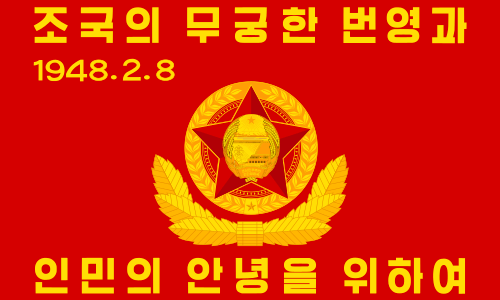
In other words, the government should not base is legitimacy of economic development but on propping up the military. Antagonizing their neighbours with their strength is a way for the government to show its legitimacy to its people. No other major communist power followed militarism to this degree. Economic development was how the USSR legitimised their rule. Industrialisation and agriculture development was used in their propaganda, not racial militarism. Even if their defence budget was colossal. North Koreas emphasis on their military is closer to Prussian or Japanese militarism than their supposed socialist brothers.
Racial Nationalism
Another way in which the North differs is the prominence of racial nationalism. BR Myers in The Cleanest Race: How North Koreans See Themselves and Why It Matters argues that racial purity is central in the Norths propaganda messages. Koreans are seen as the purist race in the world, not for any physical advantages but for their childlike virtue. This race-based nationalism differs greatly from the state nationalism of the USSR or Yugoslavia. It is again closer to Japanese nationalism or Nazi Germanys. Racial purity is routinely defended in North Korean newspapers. For example, in response to a half south Korean half American footballer being welcomed in the south Northern journalists published the following:
“Mono ethnicity is something that our nation and no other on earth can pride itself in…. there is no suppressing the nations shame and anger at the talk of a multi racial society which would dilute even the bloodline of our people.”
Again, this is not something a Soviet state newspaper would ever have published. Another example from 2013 which claimed to be the opinion from a north Korean labourer discussing Barrack Obama went as follows:
“Hideous Monkey Man, just looking at Obama’s ugly mug turns by stomach almost to the point of vomiting. That blackish mug, the vacant, ash-coloured eyes, the gaping nostrils: the more I study all this, the more he appears the spitting image of a monkey in an African jungle.
The North was smart enough not to translate this into English but published it online in Korean. The government is to some degree careful to hide the extremes of their racial views from outsiders. Still, their message routinely exudes race-based nationalism, especially since the end of the cold war.

Conclusion
If North Korea has a guiding ideology, it is militarist ultra nationalism. The combination of racial nationalism, militarism and a succession system akin to an absolute monarchy all lead to the conclusion that the North is not a communist state. Arguably it was in the 1940s and 50s but increasingly less so in contemporary times. The state is more comparable to Imperial Japan or Nazi Germany than anything reminiscent of socialism. However, there are caveats. The North does not show interest in expanding their borders to make an empire; beyond their threats to their southern neighbours who they would certainly like to annex. This differs to the Japanese and Germans. Secondly, as Myers argues in his book, North Korean militarism is less strict than imperial Japan’s or Prussia. As North Koreans are seen as a people with childlike purity, they have some room to be spontaneous. The crushing suppression of emotion seen amongst Japanese militarists was not like this. Still, North Korea is certainly on the Far right of the political map. If they were communist in the past, they certainly are no longer.
Sources
Demick, Barbara. 2009. Nothing to Envy. New York: Random House.
Myers, B.R. 2015. North Koreas Juche Myth. Sthete: Busan
Myers, B.R. 2011. The Cleanest Race: How North Koreans See Themselves and Why It Matters. Melville House: New York.
Reuters. 2024. “What are North Korea’s military capabilities and how powerful are they?” Reuters, October 25 (https://www.reuters.com/world/asia-pacific/north-koreas-military-is-one-worlds-largest-how-powerful-is-it-2024-10-25/).
Seth, Michael J. 2018. North Korea: A History. Bloomsbury: London.
The Most Hated Leader in South Korean History: Chun Doo Hwan
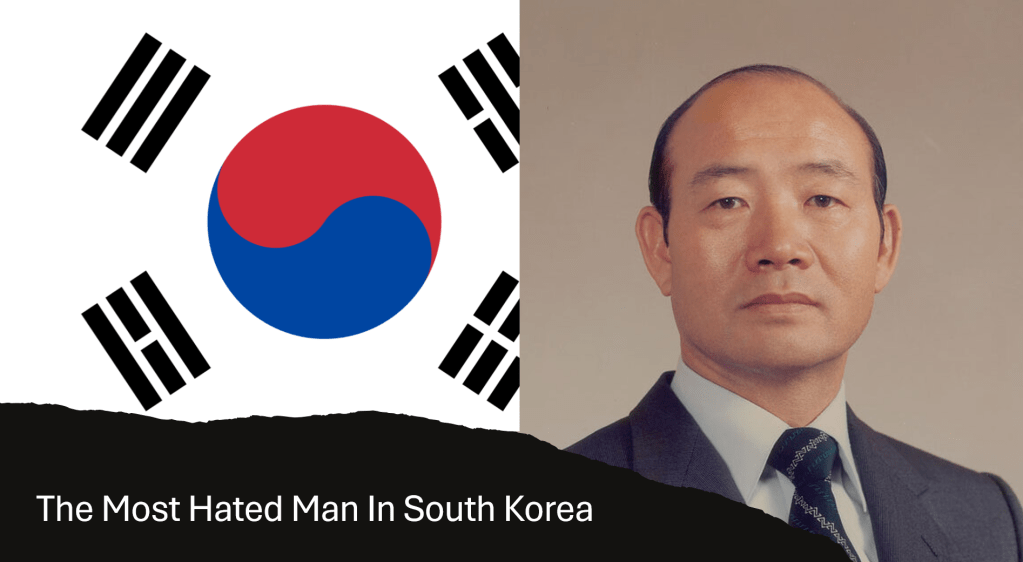
Chun Doo Hwan
The most hated leader in South Korean history: Chun Doo Hwan who ruled South Korea from 1979-1988.
Background
Born in 1931 when Korea was still a Japanese Colony. His family was working class and large: he was one of 10 children. In 1939 his father murdered a Japanese police officer by throwing him off a cliff and the family fled to Japanese controlled China for two years. They later returned to Korea and Chun enrolled in the Korean Military Academy, seeing service in the Korean War. He pursued a career in the military after the war and as a captain supported Park Chung Hee’s coup in 1961. In 1963 he was given a position within the Korean CIA and in 1970 saw service in the Vietnam War.
Coup
After Park’s assassination in 1979, Korea experienced a power vacuum. Their leader of 18 years had just died overnight, with no warning. Most Koreans hoped that the dictator’s death would lead to more democratisation. Chun dashed these hopes. In December 1979 he carried out an inter military coup to gain control of the armed forces. He followed this in May with a second coup in which he took control of the country. He quickly extended martial law, closing the universities, banning all political activities and curtailed the press. Thousands were arrested in the crackdown, including dozens of politicians.
Authoritarianism
Parks authoritarianism continued well after the coup. He continued to govern the country as a dictator until 1988. Within those years he became notorious for violently cracking down on labour and democracy protests. The most extreme example of his authoritarian governance was his establishment of concentration camps. Somewhere between 60,000 and 100,000 people were interned in Samchung re-education camp alone in the 1980s. Most of those detained were social undesirables: the disabled, orphans, the homeless and political dissidents. Allegedly some citizens were detained for simply failing to produce ID when stopped by the police. This was part of a broader Social Purification Project Chun constructed.
Gwangju
The most public symbol of Chun’s brutality was the Gwangju uprising, which broke out in the city of Gwangju in 1980. Pro-democracy protests had broken out after Parks death and became known as the Seoul Spring. When Koreans realised Chun was consolidating his power and not shifting to a democracy, the protests gained steam. Martil law was declared, and the government began cracking down. Gwangju city continued their protests as it became clear Chun was carrying out his second coup. After the police failed, killing a protestor in the process, the situation escalated into a full-blown uprising. University students battled the police with homemade weapons in street brawls. Eventually Chun decided to send in the military, including paratroopers. It is unclear how many died but one estimate I have read claimed 154 protestors were killed, 74 went missing and 4,000 were injured. The government lost 22 soldiers, and 4 policemen killed and 100 of both injured. They managed to successfully crush the uprising but at a steep cost. Chun had butchered hundreds of his own citizens simply asking for a democracy. Gwangju became a symbol for the pro-democracy movement and a rallying cry against Chun, who as a result became deeply unpopular.
Economy
Chun had more success on the economy than controlling his own citizens. Like Park, Chun’s time in power saw incredible economic growth, as you can see here on this graph. But what you can also see is that Chun gained power as South Korea experienced their first recession in 20 years. This was largely caused by international factors. Chun went about liberalising the economy along what would become known as the Washington consensus. This was the global push towards neoliberalism that Reagan was pushing for. Koreas Chaebols (family conglomerates) gained more power than ever before with less government oversight. But some companies also went bust during the opening up of the economy. The growing competitiveness of the market proved too much. Chun also understood that workers would make the country more money if they had a higher standard of education and healthcare. University attendance increased under his rule with science being prioritised over the humanities. He also gave Koreans universal healthcare which came into effect two years after he left office. All this combined contrasted sharply with the political repression experienced by workers who dared go on strike, either in support of democracy or labour rights. But it succeeded in keeping Korea on the track of high annual growth that Park’s tenure had first developed. Korea got richer.
Foreign Policy
During Chuns tenure various international incidents dominated his foreign policy. This was the 1983 shooting down of a Korean civilian airliner by the USSR which killed 269 people. Koreans were outraged, but due to the cold war were unable to retaliate. One month later North Korea bombed Rangoon, Burma killing 21 people and wounding 46. This was an attempted assassination of Chun by the North and narrowly failed. Four cabinet members were killed however including South Koreas foreign minister Lee Bum Suk. Again, Chun was pressured by the Americans not to respond for fear of escalation. Relations with the North surprisingly warmed just a few years later with cross border meetings taking place. Aid was exchanged as well as a handful of family reunions. The North eventually had enough with this stable relationship which came to end in 1986 when North Korea bombed Gimpo Airport in Seoul, killing five civilians. On top of these issues with the North Chun also had to contend with growing anti Americanism in the south. Many southerners blamed the US for supporting his dictatorship which strained Korean American relations on the ground.
Democratisation and End of Rule
Chuns rule began to unravel with the growing democratisation movement. His constitution limited his term to 7 years meaning he was expected to stand down in 1987. Due to the constant protests and riots he accepted this reality, but instead of holding democratic elections he began to groom a successor, Roh Tae Woo. This worried South Koreans who began a new wave of protests that year. In January a protestor was arrested and tortured to death. A protest was organised in his honour which resulted in the killing of Lee Han Yeol by the police. The photo of his unconscious body went viral and became a powerful symbol for the movement. In June Roh Tae Woo came out and promised democratic elections. The Chun government had caved to the long protest movement that had its first martyrs 7 years previously, at Gwangju. In December of 1987 south Koreans voted in their first democratic election since the early 1960s. It was a historic achievement.
Later years
If good people die young, Chun proved bad people die old. He lived until 2021 when he died of blood cancer aged 90. The 1990s saw him be brought before the courts on corruption and insurrection charges, along with a list of other crimes. He was found guilty and sentenced to life in prison, but this was commuted in 1997, and he was released. His legal troubles continued into the 2000s but he stayed out of jail for the remainder of his life.
Like Park, Chun’s legacy is controversial. Chun never apologised for the Gwangju uprising and he did not receive a state funeral after his death. Not even his own political party expressed official condolences to his family after his passing. He remains a vilified figure for most South Koreans who understandably blame him for delaying the shift to democracy.
Sources
Cha, Victor D and Pardao, Ramon P. 2023. Korea: A New History of South and North. Yale University Press: New Haven.
Choi, Jin. 2008. “Who is the father of the president? From a poor farmer to a rich man of Geoje Island.” JoongAng, October 30 (https://archive.ph/20130104062338/http://article.joins.com/article/article.asp?total_id=3359391&ctg=1000).
Jung, Bugyeong. 2020. “Brothers’ Home: South Korea’s 1980s ‘concentration camp.” BBC, May 31 (https://www.bbc.com/news/world-asia-52797527).
Pardo, Ramon. 2022. Shrimp to Whale: South Korea from the Forgotten War to K-POP. C. Hurst& Co: London.
Hwang, Kyung Moon. 2001. A History of Korea. Bloomsbury: London.
 Every Clime, Class and Colour