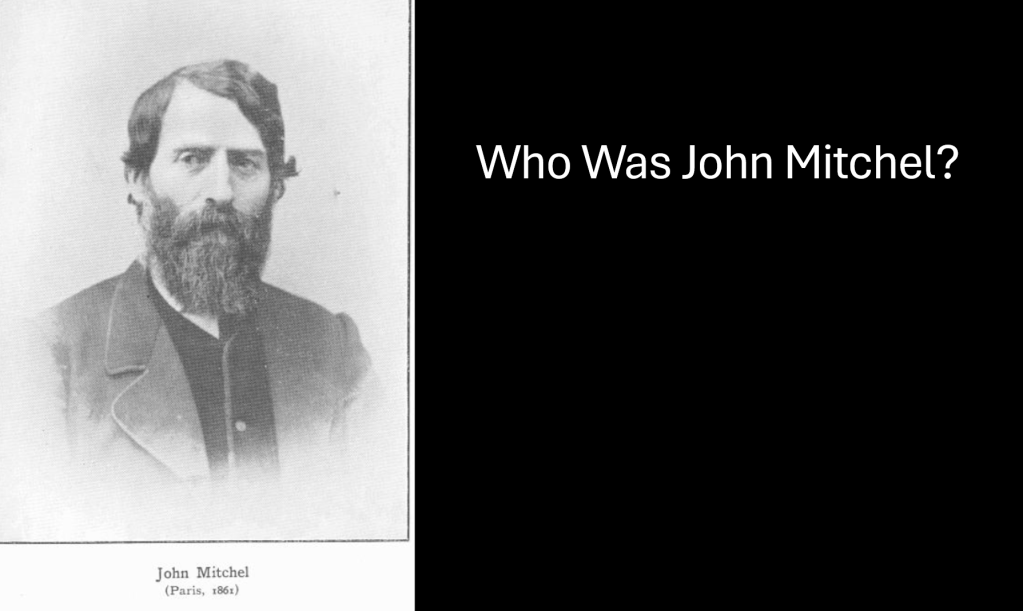
Background
Mitchel was born in Derry, Ireland in 1815 to a presbyterian minister also named John and his wife, Mary. Mitchel Senior rose to become presbyterian synod of Ulster when his son was seven but later became a focal unitarian. As to be expected Mitchel Juniors youth was steeped in religion and but later opposed all religious beliefs while studying at Trinity University.[1] After finishing his legal studies he quickly founded a practice in 1839 instead of following his father into the ministry. Through his practice he developed a nationalist attitude due to his increasing frustration over the discrimination of Catholics by Protestant magistrate. In the 1840s he became an avid writer for various nationalist newspapers and joined the militant Young Irelanders movement. He founded a newspaper himself titled the United Irishman which expressed a radical nationalist viewpoint. His writings with the Nation and United Irishman were influential with Irish historian F.S Lyons referring to Mitchel as one of the most effective journalists that century.[2] His increasingly militant writings eventually resulted in his arrested and deportation to penal colonies in Bermuda and later, Australia. His arrest was met by indignance in Ireland and contributed to the failed 1848 skirmishes of the Young Irelander Rebellion.
Early Years
Mitchell early years was marked by religious and political tension which was shared by many across Europe during those years. 1848 was a year of widespread revolution in Europe due in part to the rise of nationalism. Irelands situation at the time was one of outrage which worked as a catalyst to radicalise Mitchell and other physical force republicans. As such not only was Mitchel a writer of the Famine, but he was also a firsthand survivor and a victim of penal labour. Both these ordeals hardened his nationalist sentiment. His world and its events were interpreted by him with a hatred of the British Empire. This is entirely understandable viewpoint given his experiences. To him, he had lost years of his life incarcerated for the “Cause of ‘civilisation’ and of British Law and Order.”[3] He would write a memoir known as the Jail journal of his experiences in prison which he used railed against the Empire. It was received positively and became an influential book for Irish Nationalists the profits of which helped fund a new life for him in the United States. He continued his nationalist activities amongst the Irish American communities there until his death in 1875. As such his entire life was dominated by the national struggle, always surrounding himself with likeminded people of a similar background as he. Even his cellmate in Australia was a fellow Irish nationalist.[4]
Hatred of Modernity
As much as Mitchel believed in Irish nationalism, he had an equally strong hatred of the modern world. As a thinker he disregarded the Enlightenment and remarked in an 1854 speech that social progress was impossible.[5] The enlightened nationalism of Wolfe Tone to him was wrong. Rather he believed in a pre-industrial society made of farmers free for any form of government interference. As early as the 1840s Mitchel also expressed a hatred for modern capitalism and landlordism in the United Irishman.[6] Britain with their industrialised and commercialised empire represented the exact opposite of Mitchel’s social beliefs which contributed to his Anglophobia. But he was not a socialist, rather an extreme social conservative/revolutionary who despised leftist ideals. This along with his sense of nationalism formed Mitchel’s perception of the world. For example, he viewed the North – South divide in the United States as one between a capitalist industrial North and a free agrarian South. As such he supported the Southern States secession from the Union. Irelands relationship with Britain was the same struggle against the industrialised world. He even once claimed that compared to the “dark satanic mills” of industrialised Britain Southern chattel slavery was more humane.[7] This view would leave a stain on Mitchel’s legacy and complicates his commemoration as an influential rebel to this day.
The Last Conquest of Ireland
It was there in the United States that he began his work on The Last Conquest of Ireland (perhaps) that would become synonymous with the Famine. It was also during this time that Mitchel became an advocate for chattel slavery. He was an avid supporter for the Southern cause citing them as victims of the Northern states, just like Ireland was a victim of Britain. He even moved to Knoxville Tennessee and in 1857 began publishing the newspaper Southern Citizen to promote these views. It was in the same paper that he first published The Last Conquest of Ireland (perhaps) in 1858, eventually publishing it in book form in 1860.[8] It would become as well-known as his previous Jail Journal and would further ensure Mitchel’s contribution to Irish nationalism. The following year the United States Civil War would break out and Mitchel as well as his three sons would enlist in the Confederate Army. All seeing extensive service Mitchel would lose two sons in the War.[9] His third was also badly wounded in the conflict and his daughter would die of natural causes during the same period. After the war he continued his work with the Fenians and write extensively about Ireland. He would return to Ireland to be elected to a parliamentary seat in Tipperary before dying nine days later in 1875 and was laid to rest in Newry.[10]
Legacy
His legacy would consist of his writings, which continues to draw readers in the present day. Mitchel’s motives for his most famous work The Last Conquest of Ireland (perhaps) were of course heavily political. Fuelled by just anger at the British government the book is a political accusation as much as it is a history of the Famine. It is more rightly characterised as a Polemic work shaped by Mitchel’s worldviews. The work interprets the Famine as an intentional attempt by the British government to thin out Irelands population. In part he argued this was to clear land in Ireland to grow food for the growing industrialised population in England. This argument was first expressed by Mitchel in his writings during the Famine itself as he, in his own words, witnessed things that would have “driven a wise man mad”.[11] Mitchell’s argument has been rebuffed by modern historians but continues to be a common narrative amongst Irish nationalists. Mitchel’s view that while the blight did come naturally it was the English who created the Famine has nevertheless become a political slogan. In a sense this has proved to be successful in its purpose as a political charge as the work would radicalise and be prime motivation to further generations of Irish nationalists. Patrick Pearse was one such man and would label Mitchel’s Jail Journal “‘the last of the four gospels of the New Testament of Irish nationality, the last and the fieriest and the most sublime’.[12]
Bibliography
Primary Sources
Mitchel, John. The last conquest of Ireland (perhaps) (1861)
Mitchel, John. Jail Journal
Secondary Sources
Lyons, FS. Ireland Since the Famine (London, 1971).
Ó Cathaoir, B. ‘Mitchel Politicised the Famine’ Seanchas Ardmhacha: Journal of the Armagh Diocesan Historical Society, XX (2005) pp 155–162.
Quinn, James. Dictionary of Irish Bibliography, ‘Mitchel, John’ (https://www.dib.ie/biography/mitchel-john-a5834) (October 2009).
Russell, Anthony. ‘John Mitchel—flawed hero,’ 18th-19th Century history, XXIV (2016) p 1.
[1] James Quinn. Dictionary of Irish Bibliography, ‘Mitchel, John’ (https://www.dib.ie/biography/mitchel-john-a5834) (October 2009).
[2] FS L Lyons, Ireland Since the Famine (London, 1971) p 98.
[3] John Mitchell Jail Journal (1854).
[4] B. Ó Cathaoir ‘Mitchel Politicised the Famine’ Seanchas Ardmhacha: Journal of the Armagh Diocesan Historical Society, XX (2005) p 155.
[5] Anthony Rusell ‘John Mitchel—flawed hero,’ 18th-19th Century history, XXIV (2016) p1.
[6] Dictionary of Irish Bibliography, ‘Mitchel, John’ (https://www.dib.ie/biography/mitchel-john-a5834).
[7] Ó Cathaoir ‘Mitchel Politicised the Famine’, p 161.
[8] Dictionary of Irish Bibliography, ‘Mitchel, John’ (https://www.dib.ie/biography/mitchel-john-a5834).
[9] Rusell ‘John Mitchel—flawed hero,’ p1.
[10] Ó Cathaoir ‘Mitchel Politicised the Famine’, p 162.
[11] Mitchel, Jail Journal (1854).
[12] Rusell ‘John Mitchel—flawed hero’ p1.
 Every Clime, Class and Colour
Leave a comment