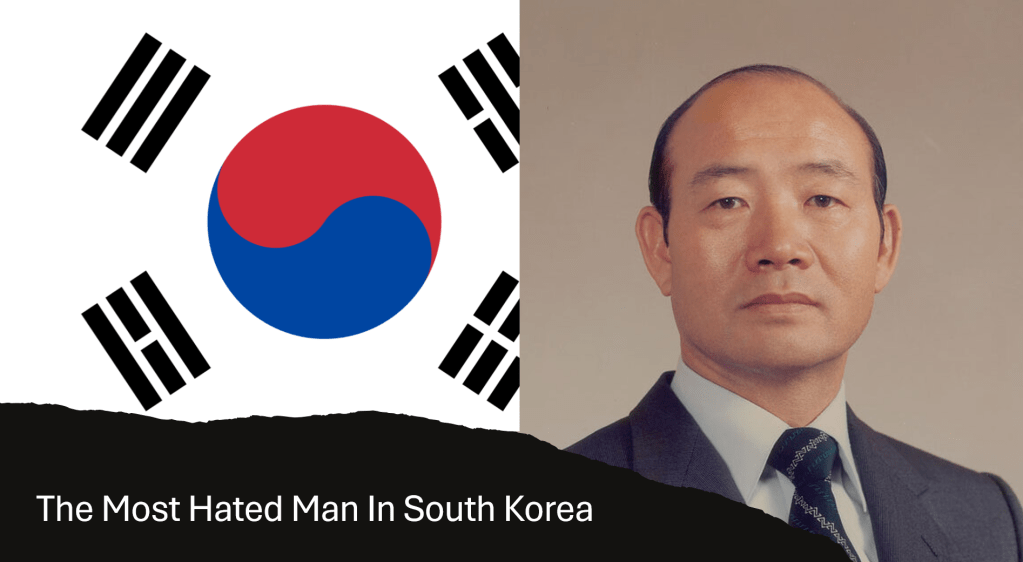
Chun Doo Hwan
The most hated leader in South Korean history: Chun Doo Hwan who ruled South Korea from 1979-1988.
Background
Born in 1931 when Korea was still a Japanese Colony. His family was working class and large: he was one of 10 children. In 1939 his father murdered a Japanese police officer by throwing him off a cliff and the family fled to Japanese controlled China for two years. They later returned to Korea and Chun enrolled in the Korean Military Academy, seeing service in the Korean War. He pursued a career in the military after the war and as a captain supported Park Chung Hee’s coup in 1961. In 1963 he was given a position within the Korean CIA and in 1970 saw service in the Vietnam War.
Coup
After Park’s assassination in 1979, Korea experienced a power vacuum. Their leader of 18 years had just died overnight, with no warning. Most Koreans hoped that the dictator’s death would lead to more democratisation. Chun dashed these hopes. In December 1979 he carried out an inter military coup to gain control of the armed forces. He followed this in May with a second coup in which he took control of the country. He quickly extended martial law, closing the universities, banning all political activities and curtailed the press. Thousands were arrested in the crackdown, including dozens of politicians.
Authoritarianism
Parks authoritarianism continued well after the coup. He continued to govern the country as a dictator until 1988. Within those years he became notorious for violently cracking down on labour and democracy protests. The most extreme example of his authoritarian governance was his establishment of concentration camps. Somewhere between 60,000 and 100,000 people were interned in Samchung re-education camp alone in the 1980s. Most of those detained were social undesirables: the disabled, orphans, the homeless and political dissidents. Allegedly some citizens were detained for simply failing to produce ID when stopped by the police. This was part of a broader Social Purification Project Chun constructed.
Gwangju
The most public symbol of Chun’s brutality was the Gwangju uprising, which broke out in the city of Gwangju in 1980. Pro-democracy protests had broken out after Parks death and became known as the Seoul Spring. When Koreans realised Chun was consolidating his power and not shifting to a democracy, the protests gained steam. Martil law was declared, and the government began cracking down. Gwangju city continued their protests as it became clear Chun was carrying out his second coup. After the police failed, killing a protestor in the process, the situation escalated into a full-blown uprising. University students battled the police with homemade weapons in street brawls. Eventually Chun decided to send in the military, including paratroopers. It is unclear how many died but one estimate I have read claimed 154 protestors were killed, 74 went missing and 4,000 were injured. The government lost 22 soldiers, and 4 policemen killed and 100 of both injured. They managed to successfully crush the uprising but at a steep cost. Chun had butchered hundreds of his own citizens simply asking for a democracy. Gwangju became a symbol for the pro-democracy movement and a rallying cry against Chun, who as a result became deeply unpopular.
Economy
Chun had more success on the economy than controlling his own citizens. Like Park, Chun’s time in power saw incredible economic growth, as you can see here on this graph. But what you can also see is that Chun gained power as South Korea experienced their first recession in 20 years. This was largely caused by international factors. Chun went about liberalising the economy along what would become known as the Washington consensus. This was the global push towards neoliberalism that Reagan was pushing for. Koreas Chaebols (family conglomerates) gained more power than ever before with less government oversight. But some companies also went bust during the opening up of the economy. The growing competitiveness of the market proved too much. Chun also understood that workers would make the country more money if they had a higher standard of education and healthcare. University attendance increased under his rule with science being prioritised over the humanities. He also gave Koreans universal healthcare which came into effect two years after he left office. All this combined contrasted sharply with the political repression experienced by workers who dared go on strike, either in support of democracy or labour rights. But it succeeded in keeping Korea on the track of high annual growth that Park’s tenure had first developed. Korea got richer.
Foreign Policy
During Chuns tenure various international incidents dominated his foreign policy. This was the 1983 shooting down of a Korean civilian airliner by the USSR which killed 269 people. Koreans were outraged, but due to the cold war were unable to retaliate. One month later North Korea bombed Rangoon, Burma killing 21 people and wounding 46. This was an attempted assassination of Chun by the North and narrowly failed. Four cabinet members were killed however including South Koreas foreign minister Lee Bum Suk. Again, Chun was pressured by the Americans not to respond for fear of escalation. Relations with the North surprisingly warmed just a few years later with cross border meetings taking place. Aid was exchanged as well as a handful of family reunions. The North eventually had enough with this stable relationship which came to end in 1986 when North Korea bombed Gimpo Airport in Seoul, killing five civilians. On top of these issues with the North Chun also had to contend with growing anti Americanism in the south. Many southerners blamed the US for supporting his dictatorship which strained Korean American relations on the ground.
Democratisation and End of Rule
Chuns rule began to unravel with the growing democratisation movement. His constitution limited his term to 7 years meaning he was expected to stand down in 1987. Due to the constant protests and riots he accepted this reality, but instead of holding democratic elections he began to groom a successor, Roh Tae Woo. This worried South Koreans who began a new wave of protests that year. In January a protestor was arrested and tortured to death. A protest was organised in his honour which resulted in the killing of Lee Han Yeol by the police. The photo of his unconscious body went viral and became a powerful symbol for the movement. In June Roh Tae Woo came out and promised democratic elections. The Chun government had caved to the long protest movement that had its first martyrs 7 years previously, at Gwangju. In December of 1987 south Koreans voted in their first democratic election since the early 1960s. It was a historic achievement.
Later years
If good people die young, Chun proved bad people die old. He lived until 2021 when he died of blood cancer aged 90. The 1990s saw him be brought before the courts on corruption and insurrection charges, along with a list of other crimes. He was found guilty and sentenced to life in prison, but this was commuted in 1997, and he was released. His legal troubles continued into the 2000s but he stayed out of jail for the remainder of his life.
Like Park, Chun’s legacy is controversial. Chun never apologised for the Gwangju uprising and he did not receive a state funeral after his death. Not even his own political party expressed official condolences to his family after his passing. He remains a vilified figure for most South Koreans who understandably blame him for delaying the shift to democracy.
Sources
Cha, Victor D and Pardao, Ramon P. 2023. Korea: A New History of South and North. Yale University Press: New Haven.
Choi, Jin. 2008. “Who is the father of the president? From a poor farmer to a rich man of Geoje Island.” JoongAng, October 30 (https://archive.ph/20130104062338/http://article.joins.com/article/article.asp?total_id=3359391&ctg=1000).
Jung, Bugyeong. 2020. “Brothers’ Home: South Korea’s 1980s ‘concentration camp.” BBC, May 31 (https://www.bbc.com/news/world-asia-52797527).
Pardo, Ramon. 2022. Shrimp to Whale: South Korea from the Forgotten War to K-POP. C. Hurst& Co: London.
Hwang, Kyung Moon. 2001. A History of Korea. Bloomsbury: London.
 Every Clime, Class and Colour
Leave a comment